




A visual journey through the adaptation delivery chain
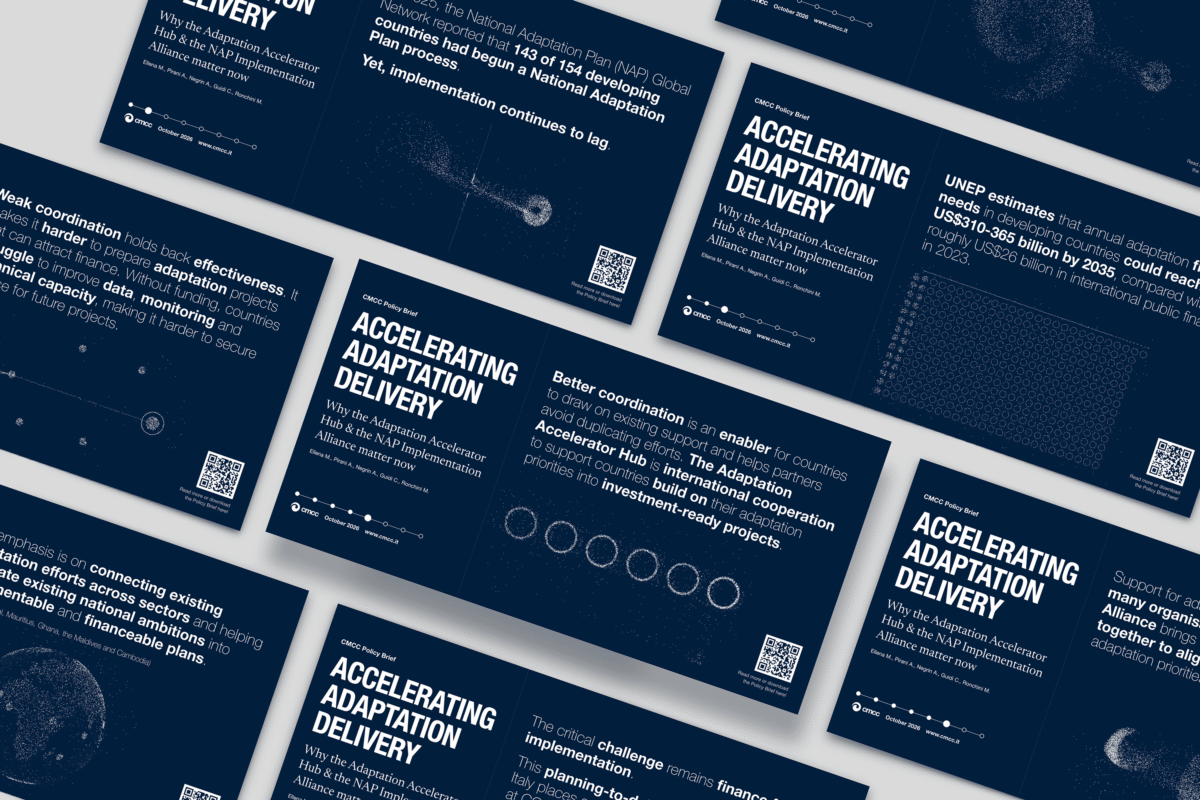
A new digital platform on climate adaptation makes climate knowledge more accessible. Developed by CMCC, this tool transforms the facts and figures behind the Accelerating Adaptation Delivery policy brief into an accessible, engaging and interactive resource that can be accessed by all interested parties; revealing how the union of science and design can make complex knowledge easier to understand and use.
CMCC launches Accelerating Adaptation Delivery, a new digital platform that reimagines how scientific knowledge on climate adaptation can be communicated and accessed. Developed in collaboration with InfoDesignLab, the platform builds on the CMCC Policy Brief Accelerating Adaptation Delivery: Why the Adaptation Accelerator Hub and the NAP Implementation Alliance matter now, translating scientific and policy insights into a visual, interactive experience designed to reach different audiences.
The initiative reflects a broader ambition: making scientific knowledge more accessible, engaging and useful beyond specialist audiences, through new ways of bringing together research, information design and digital storytelling.
The platform addresses one of today’s key challenges in climate adaptation: moving from national plans to concrete implementation. While many countries have developed National Adaptation Plans, turning priorities into investment-ready projects and mobilising the resources needed to implement them remains difficult. The Policy Brief explores how the Adaptation Accelerator Hub (AAH) and the NAP Implementation Alliance (NIA) can help bridge this gap by strengthening the connections between national priorities, technical preparation, financing and implementation.
Developing countries may need between USD 310 and 365 billion annually for adaptation by 2035, compared with just USD 26 billion in international public adaptation finance in 2023. Meanwhile, by 2025, 143 of 154 developing countries had initiated a National Adaptation Plan process, yet implementation continues to lag behind.
“The conversation on climate adaptation is moving from ‘how do we plan?’ to ‘how do we deliver and pay for it?’” says Marta Ellena, lead author of the CMCC Policy Brief, produced in support of the Italian Ministry of Environment and Energy Security (MASE), published in the build-up to COP31 in Türkiye and at the center of a side event in Antalya.
“Developing countries know what they need to do to adapt to climate change. The hard part is turning that knowledge into projects that will actually be financed,” Ellena explains. The challenge extends beyond funding itself: limited institutional capacity, fragmented coordination across national and sub-national levels, and difficulties in preparing strong project proposals all contribute to the gap between adaptation planning and implementation.
“A country-driven process that strengthens an integrated delivery chain that links national priorities, technical preparation, and investment pipelines is expected to mobilise financing, implementation and then deliver measurable results,” notes CMCC scientist Anna Pirani, co-author of the Brief.
Rather than simply reproducing the original publication in a digital format, the collaboration with InfoDesignLab has transformed its content into a new communication experience. A central element of this work is the visual representation of the adaptation delivery chain: the journey from national priorities through technical preparation, investment-ready projects and financing to implementation and measurable results.
The visual narrative also highlights the distinct but complementary roles of the Adaptation Accelerator Hub and the NAP Implementation Alliance within this process. Through information design and conceptual visualisations, these complex relationships become easier to grasp, helping readers understand both the challenges of adaptation delivery and how different initiatives can contribute to addressing them, while preserving the depth of the original scientific analysis.
“The ambition was not simply to make a PDF more attractive, nor to replace the depth of a carefully researched publication with a collection of simplified messages,” write InfoDesignLab in their rationale. “It was to create different entry points to the same knowledge: an immediate visual overview for those with only a few minutes, a concise narrative for those looking for the key messages, and a complete reading experience for those who need the full analysis.”
The platform offers three complementary ways to explore the same content:
- Home: a visual overview of the Policy Brief, where each section is introduced through a conceptual visualisation and a short text, allowing readers to grasp the main messages and navigate directly to the topics they are interested in.
- Slideshow: a short, animated visual narrative presenting the key messages of the publication.
- Full Report: a dedicated digital reading environment providing access to the complete analysis, evidence and recommendations, with the original PDF also available for download and printing.
Designed for both desktop and mobile devices, the platform offers different entry points to the same body of knowledge: from a quick visual overview to a concise narrative of the main findings, through to an in-depth reading experience.
The collaboration between scientists and designers is central to this approach. It highlights how co-design can go beyond the visual presentation of research, becoming an integral part of the process through which scientific knowledge is structured, communicated and made accessible. By combining scientific expertise with design methodologies, complex information can be transformed into clearer narratives and more engaging experiences, helping different audiences understand not only the findings of research, but also their implications.
With Accelerating Adaptation Delivery, CMCC explores how this approach can contribute to a broader reflection on the communication of scientific knowledge: the value of research also lies in its ability to reach people, inform decisions and support action.
Explore the platform: Accelerating Adaptation Delivery
Read the Policy Brief: Climate adaptation’s delivery gap: turning national plans into action