




Newly-discovered species of sea-worm from the Adriatic named after CMCC scientist
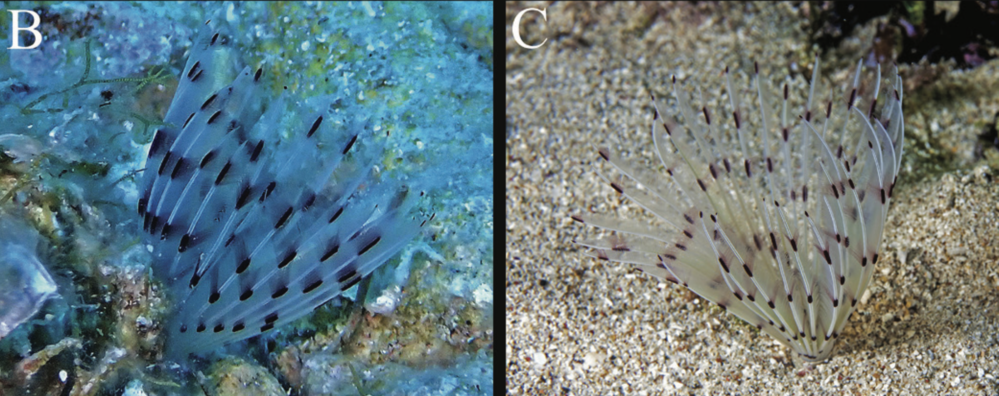
When you’re at the beach this summer, you never know what you might encounter beneath the surface. From a chance field find to a formal discovery: CMCC researcher Salvatore Causio’s early observations led to the identification of a new Adriatic tube-dwelling marine worm, years later named in his honor.
A new marine species, Bispira causioi sp. nov., has been described for the first time in a scientific paper published by the University of Salento, adding to the rich biodiversity of the Mediterranean Sea.
The species is named in honor of Salvatore Causio, a CMCC scientist who first observed and collected it in 2012 and 2014 along the Adriatic coasts of the Salento peninsula. His fieldwork was instrumental in enabling its formal identification years later.
“Curiosity is what drives our work as scientists: the desire to understand and interpret every detail of the system we study. At first glance, this discovery may seem unrelated to my daily work, but in reality it reflects the same motivation behind all ocean research,” says Causio. “Today, computers are essential tools: they help us understand processes, simulate conditions, and assess impacts. But all of this serves a larger purpose — advancing our knowledge of the blue world. That is why passion, curiosity, and the desire to learn do not stop at a keyboard. They continue whenever we have the opportunity to observe the ocean directly. In this case, even a simple recreational dive contributed to increasing our knowledge of Mediterranean biodiversity.”
This small, tube-dwelling marine worm – belonging to a group known for its delicate, fan-like feeding structures – inhabits coastal environments, where it plays a role in local marine ecosystems.
“This small polychaete is a very shy organism. It lives inside its tube and feeds by filtering particles from the water. To observe it, you need to move very gently underwater; otherwise, even a sudden movement or a slight change in light can cause it to retract immediately into its tiny tube, which is only a few millimeters in diameter, and you lose sight of its beautiful fan-like crown,” says Causio. “Species like this are important for marine ecosystems because they provide a natural mechanical filtering function. In fact, some studies and practical applications have explored the potential use of similar organisms as nature-based solutions in heavily polluted environments.”
Beyond the discovery itself, the finding highlights how much there is still to learn about Mediterranean marine life, and the importance of long-term observations in uncovering species that have remained hidden in plain sight.
“I would like to see this discovery as an ambassador for an important message: the need to study and understand our seas much more deeply. This species does not live in a remote or cryptic environment, and yet it had never been formally identified,” says Causio. “That tells us how much of the blue world we still do not know. Marine ecosystems are undergoing major transitions under the effects of climate change, including shifts in wave regimes and changes in temperature and salinity. These changes could lead to the loss — at least locally, and perhaps more broadly — of species we still do not even know exist. And yet those same species, through the ecosystem services they provide, could help us address many of the environmental challenges we face today.”