



UPTAKE Webinar
11 February 2026, h. 14:00 CET
To join the webinar, register here
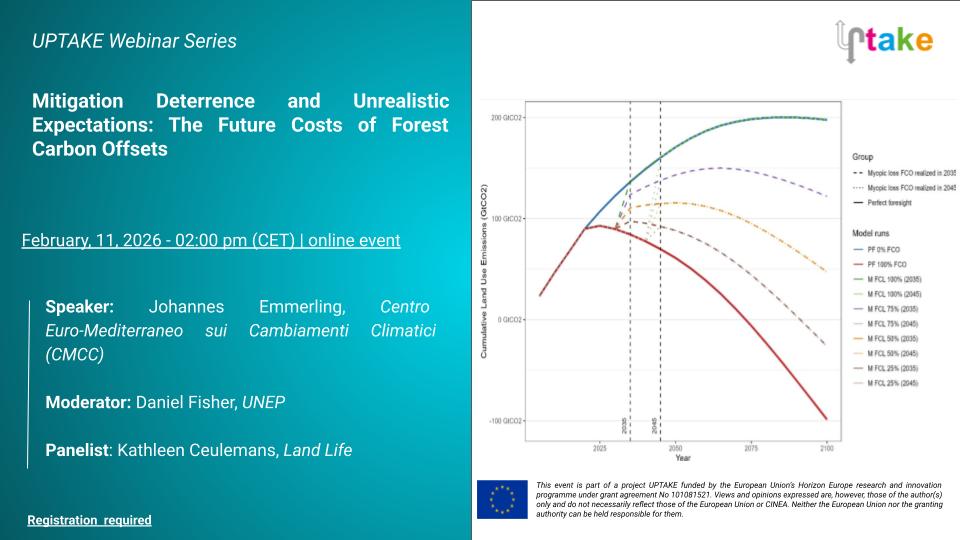
The UPTAKE monthly webinar series returns, continuing its engaging discussions on carbon dioxide removal (CDR) technologies and the latest research developments. The next session in the series, dedicated to recent publications on CDR research, will focus on the paper Mitigation Deterrence and Unrealistic Expectations: The Future Costs of Forest Carbon Offsets
Speaker: Johannes Emmerling, CMCC
Moderator: Daniel Fisher, UN-REDD Finance Specialist at United Nations Environmental Programme
Panelist: Kathleen Ceulemans, Land Life
This study examines the economic and societal impacts of using Forest Carbon Offsets (FCO) as a negative emissions technology in climate mitigation strategies. FCO includes afforestation, reforestation, and reduced emissions from deforestation and degradation (REDD) initiatives aimed at achieving global climate targets, such as limiting temperature rise to 2 °C by 2100. Despite their potential, challenges such as the impermanence of carbon storage, overestimation of carbon removal, and mitigation deterrence—where reliance on FCO reduces other climate actions—persist.
Using the WITCH integrated assessment model, this study analyzes the effects of FCO on energy sector investments, carbon pricing, and mitigation costs under scenarios with perfect foresight, myopic behavior, and varying degrees of forest carbon loss (FCL).
Results indicate that heavy reliance on FCO leads to mitigation deterrence, with renewable and carbon capture investments decreasing by 8.6 % and 31 %, respectively, while fossil fuel investments increase by 1 %. Scenarios with 100 % FCL by 2045 could increase global GDP loss by 0.5 percentage points, surpassing the costs of not using FCO. Non-OECD countries, more vulnerable with lower economic resilience, could face mitigation costs up to 1.7 percentage points higher than OECD countries in similar FCL scenarios, raising equity concerns in climate policy.
This research underscores the need for careful FCO management, accurate carbon sequestration estimates, and equitable policy frameworks to prevent moral hazards and ensure effective climate action. Clear definitions of which emissions can be offset versus those requiring direct reduction are essential to prevent over-reliance on offsets and maintain a balanced mitigation approach.
ORGANIZED BY:
The Industrial & Planetary Carbon Cycle Program at CMCC as part of the UPTAKE project. Coordinated by CMCC, UPTAKE seeks to support the sustainable expansion of CDR methods by developing reliable strategies through technical, theoretical, and practical analysis—plus interactive dialogue within a dedicated stakeholder forum.
UPTAKE is an EU-funded research project on CDR methods and knowledge coordinated by CMCC Foundation (EIEE Institute).