



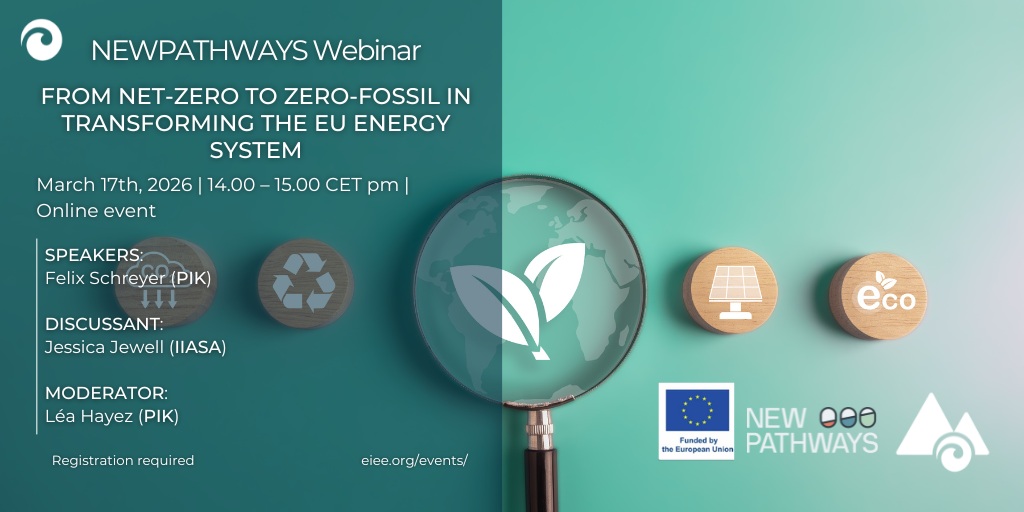
NEWPATHWAYS Webinar
17 March 2026, h. 14.00 CET
Register here
Speaker
Felix Schreyer is a post-doctoral researcher in the Energy Transition Lab at the Potsdam Institute for Climate Impact Research. His research takes a cross-sectoral view on energy transition dynamics for reaching ambitious climate targets based on integrated assessment modeling. In particular, he has published on German and European net-zero pathways and their implications for the role of hydrogen.
Moderator
Léa Hayez works with the Integrated Assessment Modelling group at the Potsdam Institute for Climate Impact Research since 2024. She is a scientific project coordinator and researcher, focusing on international climate policy, and the risks of climate change for the global economy and finance sector. Léa holds a MSc. in Energy System Engineering and previously worked on climate resilience of power systems, using participatory approaches to integrate climate risks in energy system planning.
Discussant
Jessica Jewell is a Professor of Technology and Society at Chalmers University where she leads the Energy Technology and Policy (ENTAP) group. Her research focuses on the speed and mechanisms of energy transitions with a particular interest in developing probabilistic projections of technological change and the role of policy in shaping energy transitions. She is the Principal Investigator of an ERC Starting Grant on the feasibility of climate action. Before coming to Sweden in 2019, she worked for nine years in Austria and France at an international think tank. She holds a PhD in Environmental Sciences and Policy from Central European University (Hungary), a joint Erasmus Mundus Masters from Lund, University of Manchester, and Central European University, and a Bachelors in Geology from Brown University in the US.
The EU climate neutrality goal requires a strong reduction in fossil fuel use. However, whether a complete phase-out is feasible and desirable remains unclear. Using an integrated assessment model, we quantify the additional effort needed to achieve a nearly complete EU-wide phase-out of fossil fuels by 2050 compared to a standard net-zero scenario with remaining fossil fuels. We show that in the standard net-zero scenario fossil fuel consumption already decreases by 90% from 2020 to 2050. It is compensated by renewable power, the switch to electric technologies like heat pumps and electric vehicles, as well as some hydrogen and biofuels. However, some oil and natural gas persists in hard-to-abate sectors such as the chemical industry, aviation and shipping. Phasing them out requires the large-scale deployment of costly carbon-neutral e-fuels, which substantially increases marginal abatement costs from 460 EUR to 630 EUR tCO2-1 (500-1000 EUR tCO2-1). Our works shows the additional transformation challenges if the EU aims to strengthen its climate policy commitment with a full fossil phase-out target.
ORGANIZED BY:
NEWPATHWAYS Project
Funded by the European Union. Views and opinions expressed are however those of the author(s) only and do not necessarily reflect those of the European Union or the European Climate, Infrastructure and Environment Executive Agency (CINEA). Neither the European Union nor the granting authority can be held responsible for them