



ELEVATE-ADJUST Webinar
To join the webinar, register here
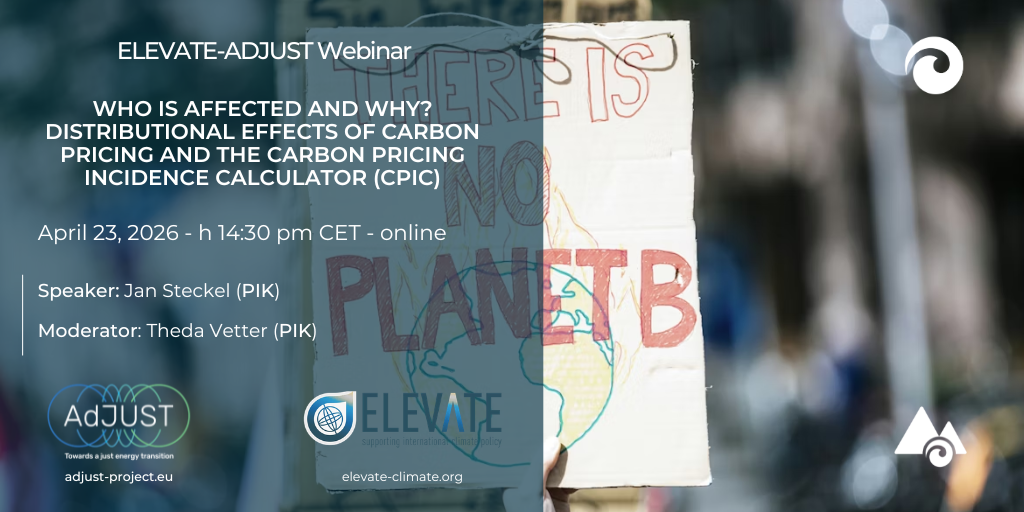
Carbon pricing is increasingly used to reduce greenhouse gas emissions and support the transition to low-carbon economies. But its success depends not only on environmental effectiveness, but also on how the costs are shared across households and whether policies are perceived as fair. While carbon pricing can encourage cleaner choices and investment, it may also place a greater burden on some groups depending on their income, location, and patterns of energy and transport use.
Can carbon pricing be designed in a way that is socially equitable and just? In this webinar we introduce an open-source tool the Carbon Pricing Incidence Calculator to provide insights for a broader policy dialogue on design and implementation of carbon pricing schemes. The tool calculates the additional costs to households after a carbon price is introduced, i.e. the carbon pricing incidence. Currently, the CPIC allows users to analyze the distributional consequences effects of carbon pricing and various compensation measures in an accessible manner for almost 90 countries.
In this webinar, the ELEVATE project researchers will address the following key questions:
- What factors determine the acceptability of carbon pricing?
- Who is most affected by carbon pricing, and how do the distributional effects differ across households?
- What types of compensation or revenue-recycling measures can reduce burdens on vulnerable households?
- How can CPIC help policymakers, practitioners, and researchers assess carbon pricing scenarios and their distributional effects?
Presenter:
Jan Steckel is Professor of “Political Economy of Climate Change” at the Technical University Munich and Head of the “Political Economy” working group at the Potsdam Institute for Climate Impact Research (PIK). His research focuses on the political economy of climate policy and energy transitions, in particular carbon pricing and compensation design, the distributional and welfare effects of climate policy reforms, and socially viable transition strategies such as coal phase out pathways. A central emphasis of his work lies on low and middle income countries and the governance of global commons, combining climate, development and public economics to design effective and socially acceptable climate policies.
Moderator:
Theda Vetter is a Policy Analyst in the Political Economy Working Group at the Potsdam Institute for Climate Impact Research. Working at the interface of research and policymaking, she leads the group’s policy engagement at the national and international levels. She is particularly interested in how evidence-based dialogue and multilateral cooperation can help countries design just climate policies that fit their own contexts. Theda holds a Master of Development Practice from the University of California, Berkeley, and a Bachelor of Science in Urbanism from Bauhaus University Weimar. Before joining PIK, she worked as a consultant for Climate Focus and Rainforest Foundation US.
AdJUST is a Horizon Europe project coordinated by the CMCC Foundation and carried out by a transdisciplinary European consortium consisting of 9 EU partners, 2 UK associated partners and other 11 EU associated partners. The objectives of AdJUST are to achieve a step change in societal understanding of the distributive repercussions of the transition to climate neutrality, and to identify effective and actively-supported policy interventions to accompany climate action so that no-one is left behind.