




Heat prevention plans help save lives

Heat prevention plans across Europe are already saving thousands of lives during extreme heat, leading to a reduction of about 25% in excess deaths attributable to extreme heat according to a new international study co-authored by CMCC researcher Shouro Dasgupta.
A new study, The effectiveness of heat prevention plans in reducing heat-related mortality across Europe published in Environmental Research Letters, evaluates how national and regional heat prevention plans – including heat-health warning systems, public information campaigns, protection of vulnerable groups and adjustments in health services – have changed heat-related mortality risks over the past three decades. Researchers analysed daily temperature and mortality data from 102 locations in 14 European countries between 1990 and 2019, combining epidemiological time-series models with a multi-country analysis.
The results show that, on average, the implementation of heat prevention plans is associated with a reduction of about 25% in excess deaths attributable to extreme heat. This corresponds to roughly 1.8 avoided deaths per 100,000 inhabitants each year, or an estimated 14,551 heat-related deaths prevented across the study regions after the introduction of these plans. The effectiveness of the plans is consistent across European regions and for different types of schemes, suggesting that a wide range of interventions can deliver substantial health benefits when adequately implemented.
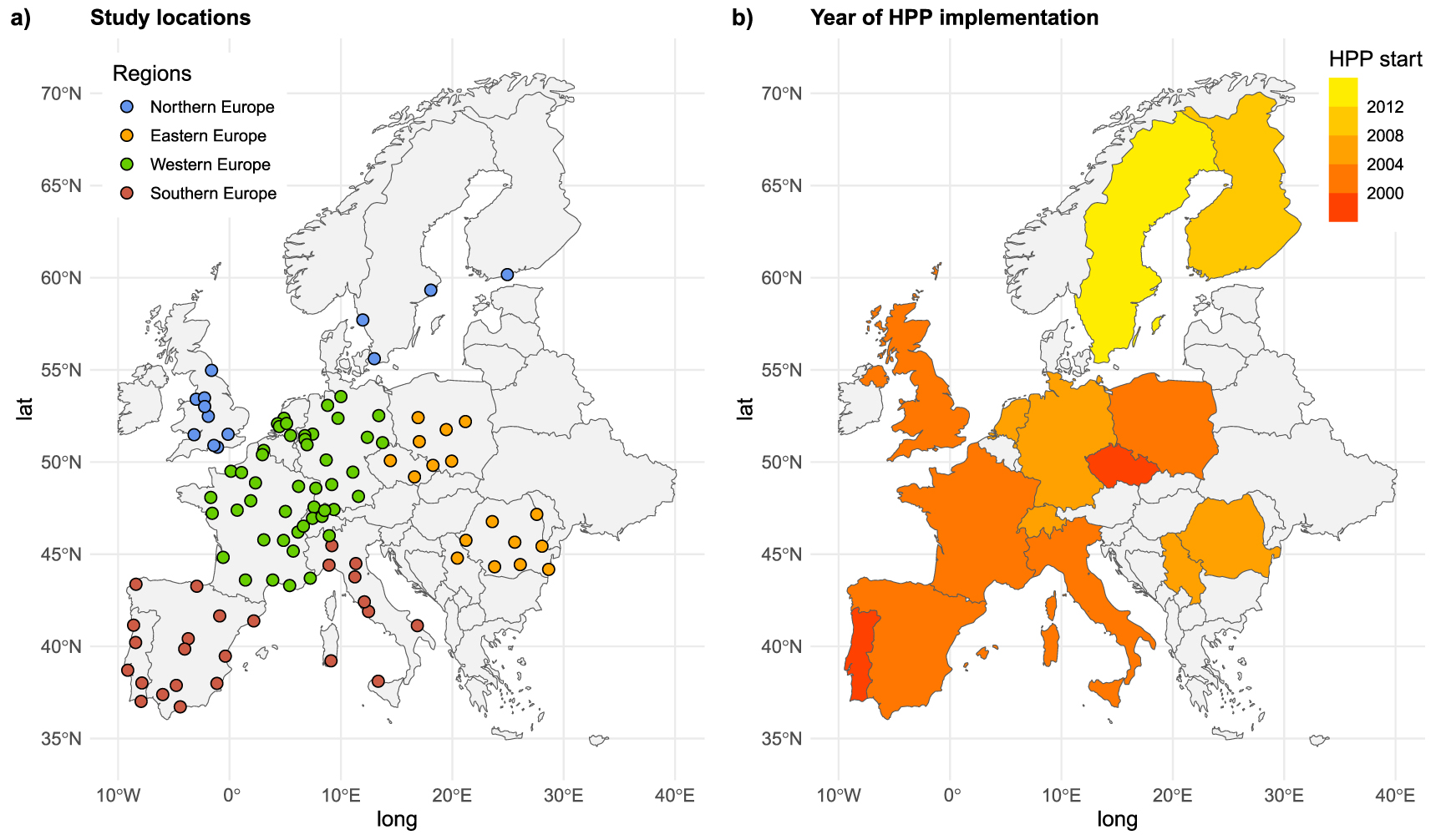
(a) Cities included in the study, (b) year of heat prevention plan implementation (HPP start) in each country. Source: Urban et al., 2025
The paper provides one of the most robust assessments to date of how adaptation policies are moderating the impacts of rising temperatures on human health in Europe. By explicitly comparing factual (with plans) and counterfactual (without plans) scenarios, the authors show that well-designed heat prevention strategies can significantly reduce mortality, even as the climate continues to warm. At the same time, they warn that increasing heat extremes may eventually push societies towards the limits of adaptation, underscoring the need for continuous monitoring, periodic updates of plans and ambitious mitigation of greenhouse gas emissions.
The findings offer crucial evidence for policymakers designing or revising heat-health action plans in Europe and beyond. They highlight that early warning systems, clear communication, and protection measures for at-risk people are not only good practice but measurably effective public health tools in a warming world.
CMCC researcher Shouro Dasgupta contributed to the study through his expertise on the socioeconomic and health impacts of climate change and on identifying vulnerable populations. His research focuses on how climate risks affect labour, food security, health and inequality, and how targeted policies can strengthen resilience, particularly for the most exposed groups.
For more information:
Urban, A., Huber, V., Henry, S., Plaza, N. P., Tušlová, L., Dasgupta, S., Masselot, P., Cvijanovic, I., Mistry, M., Pascal, M., de’Donato, F., Di Napoli, C., Gosling, S. N., Kohnová, S., Kyselý, J., Lüthi, S., Pau, L. F., Ragettli, M. S., Ruuhela, R., Ryti, N., da Silva, S. D. N. P., Zemah-Shamir, S., Thiery, W., Vicedo-Cabrera, A. M., Wieczorek, J., Sera, F., Armstrong, B., & Gasparrini, A. (2025). The effectiveness of heat prevention plans in reducing heat-related mortality across Europe. Environmental Research Letters, 20(12), 124071. https://doi.org/10.1088/1748-9326/ae2775