




Increasing the efficiency of buildings in Europe

Energy-efficient renovation investments for buildings in the European Union need to increase by roughly 18% to significantly reduce energy demand and emissions, according to a new CMCC study that helps quantify the financial needs of the energy transition. “This study helps provide a science-based approach to quantifying how much and where to expect and promote private investment and public support for a renovation wave that can lead the European building stock towards decarbonisation by 2050,” says lead author and CMCC researcher Enrico Cofler.
The building sector is responsible for about 31% of global CO₂ emissions, with 82% stemming from energy use during building operation and the remaining 18% from embodied emissions. At the European level, the Energy Performance of Buildings Directive establishes ambitious targets for national building stocks. Its ultimate aim is to achieve full decarbonization by 2050, primarily by reducing energy consumption in existing buildings through renovation and by making zero-emission standards the norm for new constructions.
In Italy, recent incentives for energy-efficient renovations have been criticised for being inefficient, indiscriminately distributed and lacking in forward-looking and effective planning from the perspective of public finances.
In this context, understanding how operational energy demand will develop in the coming decades is essential, as it allows policymakers to refine current strategies and identify the most effective measures to lower the sector’s energy-related impacts.
“Our work seeks to promote a science-based approach, on a European scale, to understand not only how much, but where to expect and promote private investment and public support for a renovation wave that can lead the European building stock towards decarbonisation by 2050,” explains Cofler. “In other words, renovation needs, the required private investments, and how much public money should help pay for them, depend heavily on specific regional climates, building age, and local economies.”
The study estimates that public funding for renovations needs to rise roughly tenfold to match private spending, a major shift from current European financing. More generally, a future for the building stock characterised by low energy demand is possible, and by taking into account both private investment and public expenditure, this can be achieved by increasing the money currently spent on energy efficiency across Europe by 18%.
A changing landscape
The study shows space heating demand will fall sharply and fairly evenly across Europe, while space cooling demand will rise and vary enormously by location (concentrating in urban hotspots like the Po Valley, Île-de-France, and Madrid/Barcelona).
It also surfaces a counterintuitive finding worth highlighting: optimally-targeted renovations can actually increase the gap between high- and low-energy-intensity areas, which complementary demand-side measures help offset.
In terms of numbers this equates to: an increase in total renovation investment needs by 18% versus historical trends (from 362 to 428 billion euros); roughly 2% annual renovation rate emerges as a cost-effective sweet spot; public support should rise by about ten times to roughly match private investment (shifting the current 20:1 private-to-public ratio toward around 1:1); the ambitious Low Energy Demand scenario delivers a 74% cut in building-sector emissions and 84% electrification by 2050, with a 31% energy-demand cut already by 2030.
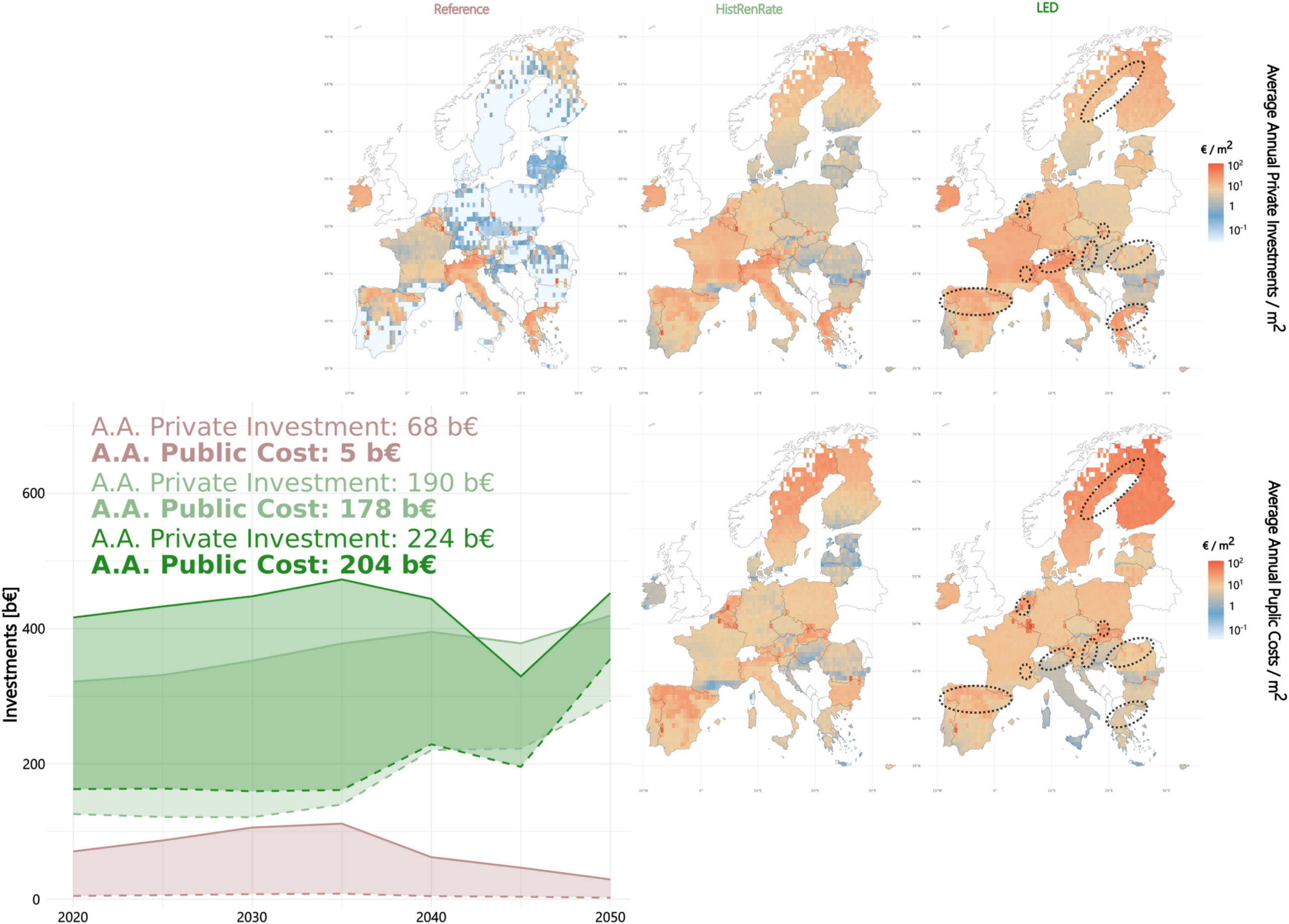
Average Annual (A.A.) Private Investments and Public Costs per local floorspace, along the three scenarios between 2020 and 2050 (public cost in the Reference scenario is not shown here). In the inset in the bottom-left corner, the Annual Average Private Investments and Public Costs are also reported along the three scenarios between 2020 and 2050, and the annual averages in numbers. Areas delimited by dashed lines are the hotspot identified for their high investment density, both in terms of m2 and local GDP. Source: Cofler et al., 2026
“It is important to provide long-term perspectives, inter-state comparability of results within Europe, and most importantly quantify the financial needs of the energy transition,” says Cofler. “It is even more crucial to do so for the demand-side policies, like the ones on energy efficiency of buildings, which are often considered as unachievable or a nice-to-have, while they are actually complementary to the supply-side policies and equally necessary. They can be a general net benefit for society as a whole, and even more effective, if accurate estimates on costs and achievability of targets are given, and this research contributes exactly to this.”
For more information:
Cofler, F.P. Colelli, G. Falchetta, M. Tavoni, Modeling policies for the EU building stock decarbonization at sub-national resolution, Energy and Buildings, Volume 362, 2026, 117521,ISSN 0378-7788, https://doi.org/10.1016/j.enbuild.2026.117521