




Italian Environment and Energy Security Minister at CMCC: Climate research serving the country’s resilience
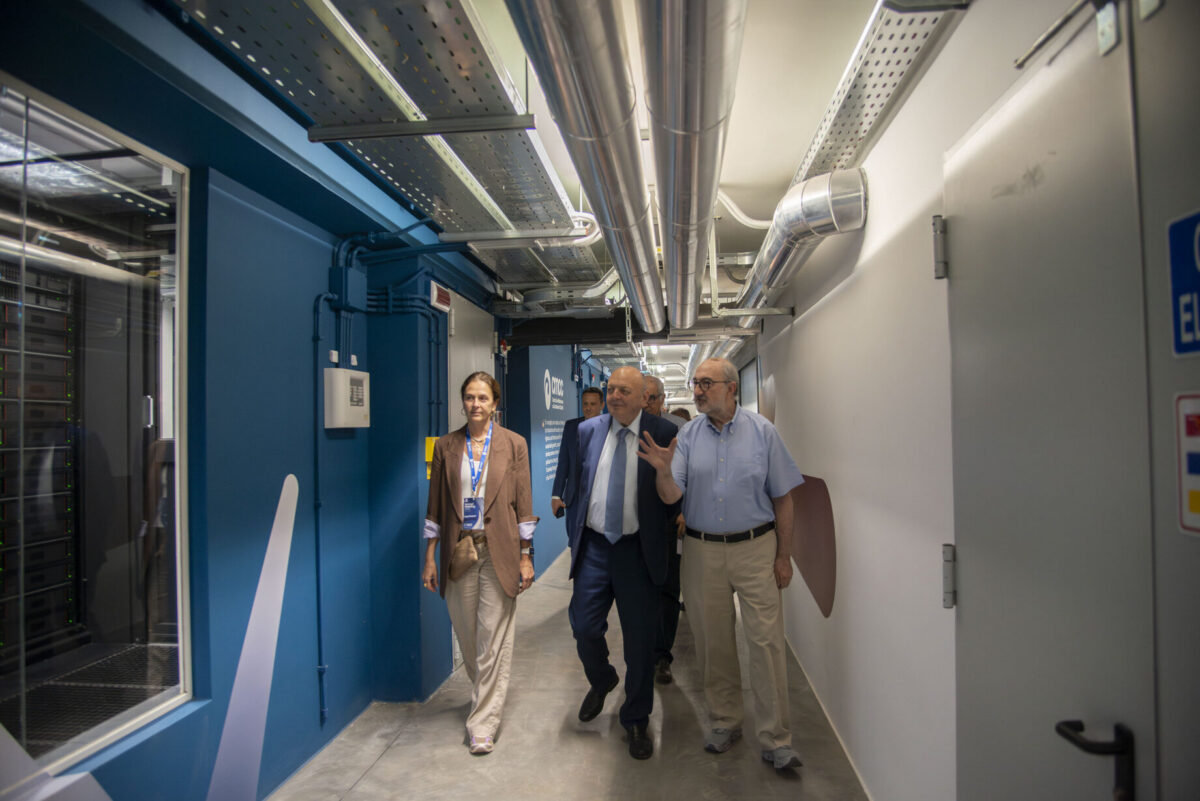
“An excellence center capable of providing information that can guide actions and behaviors.” The strategic role of climate science in supporting public policies, territorial resilience, and the country’s ability to address the impacts of climate change was at the core of Minister Pichetto Fratin’s visit to the CMCC headquarters in Lecce. Experts from the Center illustrated the importance of developing climate scenarios, risk and impact analysis, and oceanographic and Mediterranean forecasting for a more resilient country and society.
As temperatures continue to rise, heatwaves become more severe, extreme weather events occur more frequently, and energy security challenges grow increasingly complex, climate research is playing a crucial role in strengthening national resilience. Scientific knowledge and data-driven analysis are essential to help anticipate risks and support informed decision-making.
Against this backdrop, Gilberto Pichetto Fratin, Italy’s Minister for the Environment and Energy Security, visited CMCC’s headquarters in Lecce, where the supercomputing center is also located — the most important in Europe entirely dedicated to climate studies, climate data analysis, and the development of models for simulating and forecasting climate change.
“I visited the CMCC headquarters in Lecce with great interest,” said Minister Pichetto Fratin commenting on the visit. “With its 500 researchers, CMCC represents a cutting-edge reality not only at the national level but also internationally, particularly for its data processing capabilities. It is a center of excellence that provides public administrations, the state system, and the private sector with information capable of guiding actions and behaviors.”
During the meeting, CMCC President Antonio Navarra, supported by Executive Director Laura Panzera together with scientists Anna Pirani, Paola Mercogliano, and Giovanni Coppini, presented to the Minister some of the Center’s main scientific and project initiatives developed to support climate policies, adaptation, and resilience.
Among the projects presented was the Digital Twin of the Ocean, an advanced platform that combines satellite observations, numerical models, artificial intelligence, and high-performance computing to simulate future scenarios, support coastal management, and improve forecasting and response to climate-related impacts. CMCC is playing a leading role in Europe in the development of Digital Twin technologies for oceans and coastal areas, which are increasingly important in addressing challenges such as coastal erosion, flooding, and sea-level rise.
The visit also highlighted CMCC’s role in CoastPredict, an international initiative under the United Nations Decade of Ocean Science for Sustainable Development focused on improving forecasting capabilities and strengthening the resilience of coastal communities. CMCC hosts the initiative’s secretariat and coordinates international scientific activities aimed at advancing observation systems, forecasting tools, and decision-support services for coastal regions around the world.
Particular attention was also given to the contribution of CMCC researchers to international climate negotiations and to the work of the IPCC, the United Nations Intergovernmental Panel on Climate Change, for which CMCC serves as Italy’s Focal Point. Scientists from the Centre are actively involved in major international climate assessment processes, helping to produce the scientific knowledge that informs global climate policies and mitigation and adaptation strategies.
The visit concluded with a discussion of CMCC’s collaboration with public institutions and local authorities to turn climate science into practical tools for planning and adaptation. These initiatives include partnerships with the Italian State Property Agency, scientific support for Rome’s Climate Adaptation Strategy, and the development of Dataclime, a digital platform providing climate data, scenarios, indicators, and analytical tools to help public administrations, businesses, and stakeholders assess climate risks and design resilience strategies.