




Revolutions in climate and science: AI and the future of research
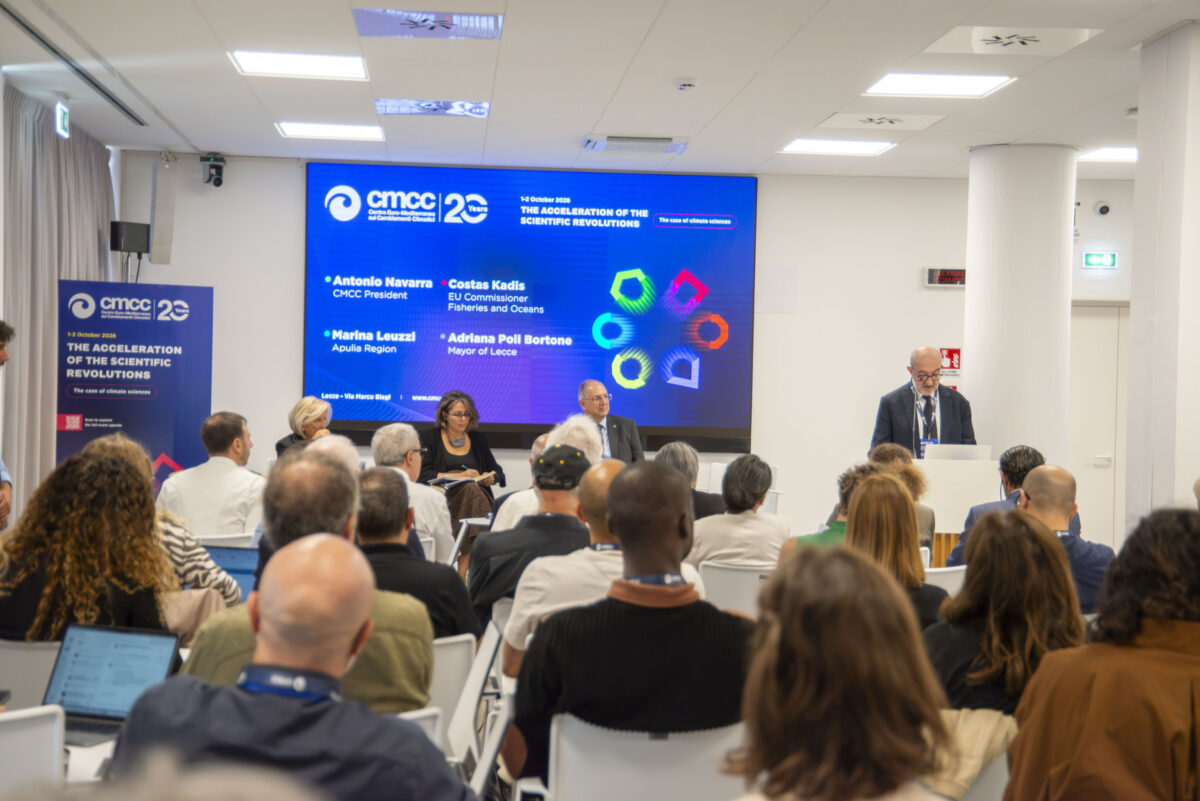
Two days, six sessions and one central theme: how AI is accelerating scientific revolutions. CMCC organised its first international symposium on the scientific challenges posed by AI in climate research, bringing together researchers, policymakers and businesses. “The outcomes and the quality of the discussions at this inaugural event have encouraged us to establish it as a regular forum for international dialogue,” said CMCC Vice-President Donatella Spano.
Thirty-five speakers representing 19 international organisations – including research centres, universities, European and national institutions, local authorities and businesses – took part in CMCC’s first symposium on “The Acceleration of Scientific Revolutions: The Case of Climate Sciences.” With opening remarks by European Commissioner Costas Kadis, the event stood out for its strongly interdisciplinary approach. Since CMCC was founded, this has been one of the defining features that have made it a leading centre for climate science, both in Italy and internationally, and an important interface for bringing scientific knowledge to public and private decision-makers and communities.
“For this first edition, we focused on the acceleration of scientific revolutions,” says Donatella Spano, CMCC Vice-President and coordinator of the symposium’s scientific committee. “We wanted to understand how the emergence and evolution of AI are requiring science to prepare for rapid methodological leaps in response to the sudden and far-reaching changes brought about by technology, together with the opportunities and challenges they create. This event was conceived to celebrate the leading role CMCC has played at the frontiers of advanced science over the past 20 years.”
The six sessions explored the role of artificial intelligence across different areas of climate research. Experts and scientists discussed how climate projections and economic analysis inform finance, investment and decision-making by governments and businesses, with contributions from institutions including the European Commission and the European Central Bank.
The programme also examined the links between the climate crisis and nature loss, from integrated scenarios to governance; the role of AI in reshaping our ability to anticipate extreme events; the development of digital twins of real-world systems and ultra-high-resolution simulations; and the pathways, methods and technologies needed to build a net-zero society.
Alongside these five themes, a special session entitled “Climate Science for a Changing World” paid tribute to Antonio Navarra. A physicist trained at the University of Bologna and Princeton’s Geophysical Fluid Dynamics Laboratory, Navarra founded CMCC and has led it for more than 20 years, building an institution where climate physics, economics and resilience come together.
The symposium highlighted a challenge facing both science and society – one that, CMCC began addressing at an early stage: “We are among the first institutions to analyse and explore these issues in depth. We want to ensure that this does not remain an isolated celebratory event, but becomes a regular forum for international dialogue within the scientific community, involving institutions, businesses and civil society,” concludes Spano.
Read our full article on the AI revolution on CMCC’s LinkedIn channel.