




Science, politics and a future with AI: CMCC Symposium on scientific revolutions underway in Lecce
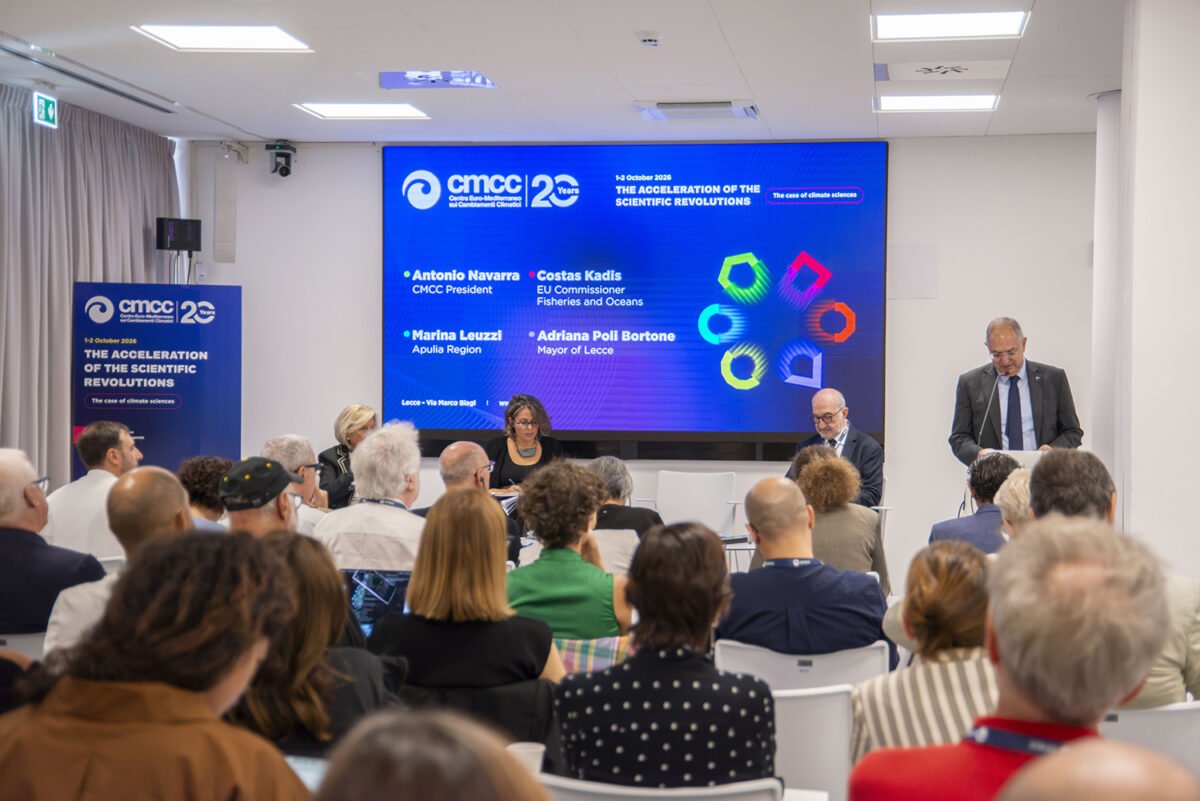
Democracy without science becomes fragile and science-based knowledge is one of the bedrocks of the European Union. This is the message with which the CMCC Symposium, The Acceleration of the Scientific Revolutions, kicked off, as experts gathered to discuss the role of research in tackling scientific and societal challenges. “Politics needs science as political credibility in terms of environmental protection and sustainability depends on reliable and accessible knowledge,” says EU Commissioner Costas Kadis in his opening remarks.
New technologies are progressing at unprecedented rates with issues such as the current and future role of Artificial Intelligence in our societies increasingly taking center stage. This leads to the question: how will new technologies and the paradigm shifts that they engender influence the scientific process and climate science?
The remarks by European Commissioner for Fisheries and Oceans Costas Kadis, CMCC President Antonio Navarra, Apuglia Regional Councillor for Marine and Coastal Policies Marina Leuzzi, and Mayor of Lecce Adriana Poli Bortone opened the symposium “The Acceleration of the Scientific Revolutions: The Case of Climate Sciences,” which began today at the CMCC headquarters in Lecce, bringing together some of the leading international figures from the worlds of science, policymaking and business.
“The way we create and apply scientific knowledge is changing fundamentally and nowhere is this shift more evident and needed than in climate science,” says Commissioner Kadis as he joined Navarra in opening the proceedings in Lecce. “CMCC’s work over the past two decades has been influential and important, consistently bridging the gap between research and policy and helping us understand and manage complex environmental systems.”
What is clear is that scientific progress no longer follows a steady evolutionary path but unfolds through leaps and bounds, enabled by new ways of processing, analysing, and exploiting vast amounts of data.
This rapid technological transformation represents a break with the past. The huge uptake in AI and ML across scientific practice – and society more broadly – has meant that researchers will need to adapt, rethink methodologies, epistemological assumptions, and institutional cultures.
The issue of how climate science will navigate these technological revolutions is at the heart of proceedings at the Symposium, bringing together international scientists, policymakers, and experts in a high-level forum where they reflect on how science is responding to this disruptive moment, while examining the implications for governance, policy, and society.
“Science has also played a less visible role. In a democratic society power is balanced by other powers and a democracy that relinquishes this reference point grows more fragile,” says Navarra. “Europe was not built only on treaties, markets and currencies; it was also built on science, which has been one of the EU’s common languages […] Europe can and must be the place where scientific freedom is guaranteed. But, it is a freedom that carries a responsibility to provide honest, timely and reliable information.”
Three requisites that form the backbone of providing accurate information for decisionmakers. “To make our policies more proactive in terms of protection and sustainability we need more and better ocean observation data and knowledge. Credible ocean policy depends on trusted and accessible knowledge,” continues Kadis.
A view that was also echoed by Leuzzi: “The challenge for politics and administrations is to embrace the complexity of global transformations due to climate change which is no longer an emergency but a reality. Research and science are the fil rouge and the common language of Europe and also of the necessary action that can help communities adapt and build integrated systems to face these challenges.”
“For a city like Lecce climate change isn’t an abstract concept but a reality that calls on us to rethink our relationship with the sea and environment and resilience planning has to become part of our climate adaptation plans” echoes Poli Bortone.