




Strengthening international scientific cooperation on Coastal Resilience: DCC-CR and CMCC meet the Mega-Delta research team in Shanghai
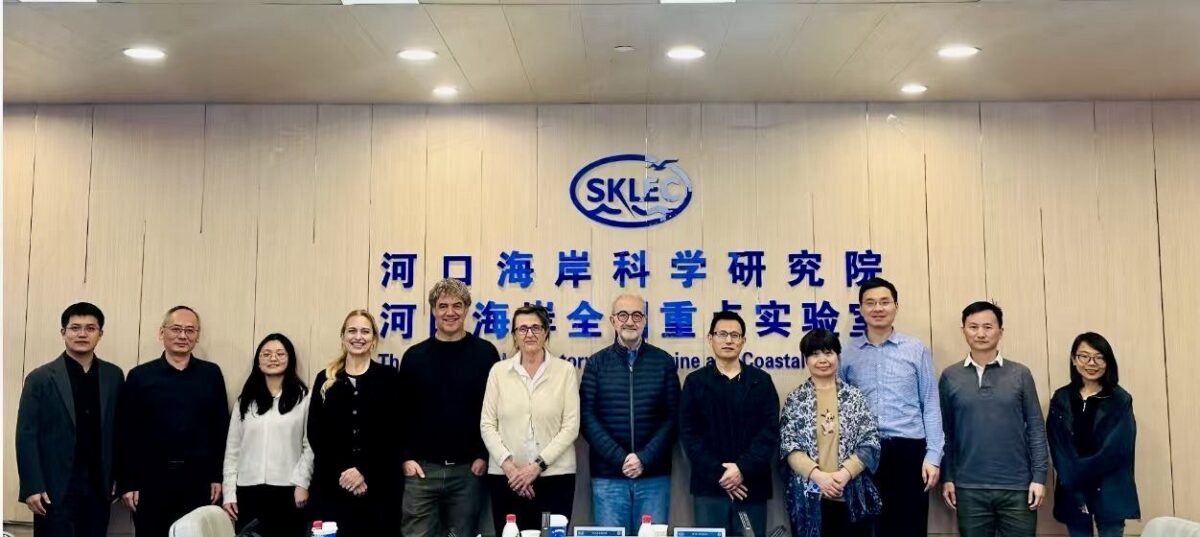
A scientific meeting hosted by the State Key Laboratory of Estuarine and Coastal Research (SKLEC) at East China Normal University provided an opportunity to consolidate ongoing partnerships, exchange research expertise and explore new avenues for international collaboration on Coastal Resilience.
As part of their institutional visit to China, Professor Nadia Pinardi, Director of the Decade Collaborative Centre for Coastal Resilience (DCC-CR), Professor Antonio Navarra, President of the Euro-Mediterranean Center on Climate Change (CMCC), and Giovanni Coppini, CMCC Project Director, met with Professor Xiuzhen Li and the research team of the Mega-Delta Programme at the State Key Laboratory of Estuarine and Coastal Research (SKLEC), East China Normal University, in Shanghai.
SKLEC is a leading Chinese research institution specialising in estuarine and coastal processes, with expertise spanning sediment dynamics, coastal geomorphology, ecosystem functioning and environmental change. Professor Xiuzhen Li, whose research focuses on coastal wetland ecology, ecosystem processes and restoration, is a leading figure in the Mega-Delta Programme, an initiative endorsed by the United Nations Decade of Ocean Science for Sustainable Development (2021–2030). The Programme brings together international scientific expertise to address the environmental and societal challenges facing major river deltas worldwide.
The meeting provided a valuable forum for scientific exchange. Researchers presented their latest work, shared their areas of expertise and discussed recent findings across complementary fields of coastal and estuarine science. These exchanges highlighted opportunities to connect different research approaches, strengthen interdisciplinary cooperation and identify shared scientific priorities.
Discussions also focused on the development of new joint research initiatives and the advancement of existing collaborations, building on the established relationship between the Mega-Delta Programme and the DCC-CR within the framework of the UN Ocean Decade. Particular attention was given to translating complementary scientific capabilities into coordinated research activities and strengthening the contribution of international partnerships to coastal resilience.
The programme continued with a field visit to Shanghai’s coastal seawall system, located along the Yangtze River estuary. This extensive coastal infrastructure illustrates the complex interactions between coastal protection, sediment dynamics and land reclamation in one of the world’s largest deltaic urban regions. Over time, engineering interventions along Shanghai’s coastline have supported the creation of new land through the management and accumulation of estuarine sediments, while seawalls provide an important defence against coastal flooding and storm surges.
The visit offered an opportunity to consider the scientific and management challenges associated with large-scale coastal engineering, including land subsidence, changing sedimentary processes, sea-level rise and the need to balance coastal development with ecosystem conservation.
Bringing researchers together in person, combining scientific dialogue with direct observation of coastal environments, is essential to building effective and lasting international partnerships. Such exchanges create the conditions for identifying shared research questions, developing complementary expertise and transforming scientific cooperation into concrete joint initiatives.
The Shanghai meeting represents a further step towards closer collaboration between DCC-CR, CMCC and the Mega-Delta research community, reinforcing their shared commitment to advancing scientific knowledge and developing solutions for more resilient and sustainable coastal and delta regions worldwide.