




Stronger climate action promotes economic development
AI reveals critical gaps and hidden opportunities in global climate pledges. A new Nature Communications study led by CMCC researcher Francesca Larosa shows how national climate plans often overlook key development priorities, but also uncovers strong synergies that could simultaneously advance climate action and sustainable development.
When governments pledge to cut emissions, they are not only talking about tonnes of CO₂. They are also shaping the future of food, water, energy, cities, jobs and health systems. Yet are these climate commitments really aligned with countries’ broader development goals? A new study led by CMCC researcher Francesca Larosa and published in Nature Communications takes a hard look at this question – and finds both critical gaps and powerful untapped opportunities.
The research, titled Critical misalignments in climate pledges reveal imbalanced sustainable development pathways, uses artificial intelligence to analyse Nationally Determined Contributions (NDCs) submitted by 158 countries under the Paris Agreement. By systematically comparing these pledges with the United Nations Sustainable Development Goals (SDGs), the authors show where climate and development agendas reinforce each other, and where they risk drifting apart.
“The findings challenge a longstanding concern among policymakers and the general public that stronger climate action could constrain economic development,” says Larosa. “Quite the opposite: this research shows that integrating climate and development objectives can create significant benefits for both people and the planet.”
Inequalities written into climate plans
The study shows that more than half of the countries analyzed (55.1%, representing 87 Parties) do not explicitly reference the SDGs in their climate plans. However, advanced text analysis revealed that many countries still address sustainable development priorities implicitly through discussions of adaptation, resilience, agriculture, health, and social welfare.
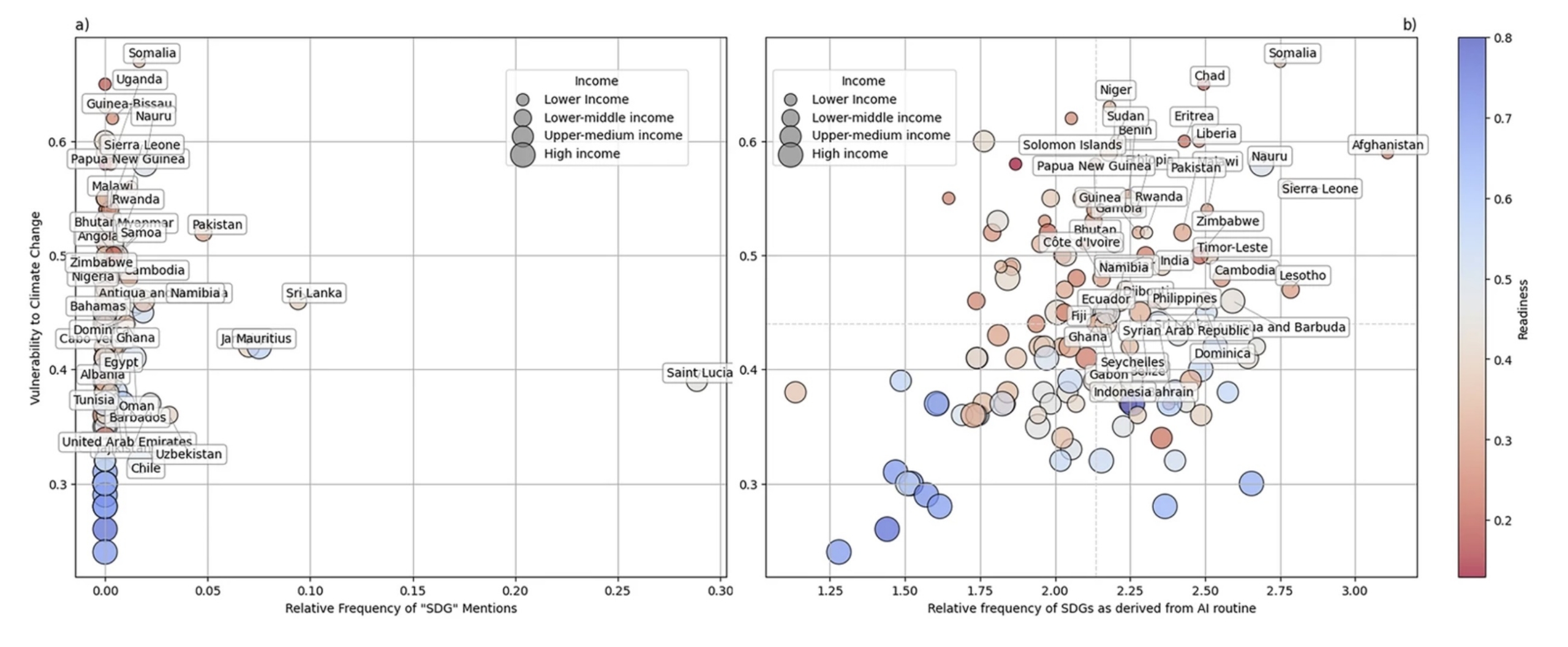
More than half of the countries analyzed (55.1%, representing 87 Parties) do not explicitly reference the SDGs in their climate plans. Source: Larosa et al., 2026
A clear divide also emerged between countries. Wealthier nations tend to focus primarily on climate mitigation and emissions reduction, while countries in the Global South place greater emphasis on social challenges such as poverty and hunger. Nations facing the highest climate risks often demonstrate the strongest integration of sustainable development concerns, reflecting the urgent realities they confront and suggesting they need to be heard much more.
Promises to cut emissions shape practical choices about food, water, energy, cities, health, jobs and finance. Climate plans often depend on expensive infrastructure such as power grids, roads or clean technologies, but governments must also protect drought-hit water systems, fisheries and rural livelihoods. While pledges may widen inequality if governments focus on the future without attending to the present, that doesn’t have to be the case. One example of a policy that balances these needs, from the Caribbean, pairs investments in climate adaptation in areas susceptible to increasing cyclones and flooding with livelihood insurance for low-income workers affected by disasters.
Paying for the transition
The research also highlights important implications for international climate finance. Many low- and middle-income countries are simultaneously dealing with climate vulnerability and growing debt burdens, limiting their ability to invest in resilience and sustainable growth. By identifying recurring links between climate goals and development priorities, the study points to opportunities for more effective financing mechanisms.
“For example, forest conservation and biodiversity protection frequently appear alongside agricultural development objectives, particularly in Sub-Saharan Africa. Such linkages suggest that instruments like debt-for-nature swaps could help address environmental, climate, and financial challenges simultaneously,” says Larosa.
Another key finding is that climate and development synergies substantially outweigh trade-offs. Across the NDCs analyzed, positive interactions between climate action and other sustainable development goals were far more common than negative ones. This suggests that policymakers have significant opportunities to design integrated strategies that generate multiple benefits across sectors.
A matter of geopolitics
The study also explores the geopolitical dimensions of climate action. Countries affected by conflict, political instability, and weak institutions increasingly reflect these challenges in their climate commitments. The findings underscore how peace, governance, and institutional capacity are critical enablers of effective climate action.
“At a time of rising geopolitical tensions, climate policy could provide a platform for renewed international cooperation. Shared climate risks and common development challenges may create opportunities for new alliances that transcend traditional political divides,” says Larosa.
Beyond its substantive findings, the research demonstrates how artificial intelligence can be applied responsibly to public policy analysis. “We designed and validated the framework used to map national climate pledges to the Sustainable Development Goals, identify synergies and trade-offs, and interpret what these patterns mean for climate finance, just transition planning and multilateral governance,” says Larosa. “Our use of large language models and substantial human validated framework shows how scalable ex-ante policy exercises can be, supporting the work of IPCC and UNFCCC.”
By reviewing hundreds of pledges in a consistent way, the framework helps detect patterns that would be extremely difficult to see through manual analysis alone. It also offers a tool that can be updated as new NDCs are submitted, making it possible to track whether future rounds of climate pledges do a better job of integrating development concerns
The findings come at a particularly important moment. As countries are reviewing and updating their commitments, this timely study can offer them important lessons on how to benefit from climate action to advance their sustainable development plans.
For more information
Larosa, F., Mallor, F., Hoyas, S., Conejero, A. J., García‑Martínez, J., Fuso Nerini, F., Vinuesa, R. (2026). Critical misalignments in climate pledges reveal imbalanced sustainable development pathways. Nature Communications, 17, 4719. https://doi.org/10.1038/s41467-026-73564-5