




The “Romeo Bassoli” Prize 2026 goes to Daniele Moretti and AFP.
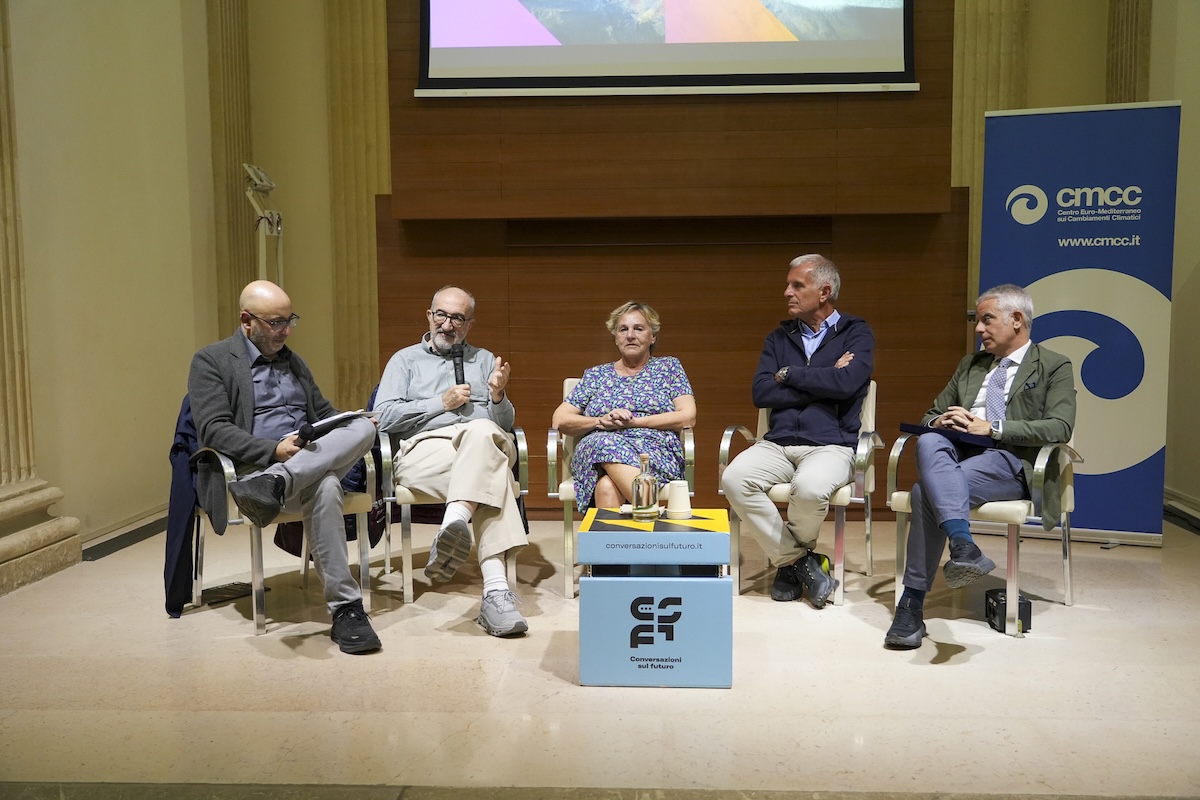
Public trust, the preparation of those who report on climate, and the legacy of Romeo Bassoli, who brought science into the news: these were the themes that emerged in Lecce at the presentation of the CMCC Prize 2026, which for the first time looks beyond Italy’s borders.
When Romeo Bassoli created the first science page in an Italian daily newspaper, he brought to the media landscape an innovation born of his extraordinary intuition: science is an essential part of everyday life and of the news and, as such, of the culture of a community and of an entire country. Thirteen years after his death in 2013, that idea returned to the centre of the evening on which the Euro-Mediterranean Center on Climate Change (CMCC) presented the 2026 “Romeo Bassoli Prize for Science Journalism on Climate”.
The award ceremony took place on the evening of Thursday 15 October in the Sala Teatrino of the Convitto Palmieri, as part of the Conversazioni sul Futuro Festival.
Daniele Moretti, deputy director of Sky TG24, and AFP – Agence France-Presse, for its Future of the Planet project, in the international journalism category, received the prize from CMCC President Antonio Navarra and led an in-depth panel on the themes of climate journalism.
The jury, made up of Eva Benelli, Silvia Bencivelli, Mauro Buonocore, Luca Carra and Cristiana Pulcinelli, recognised Moretti for bringing climate change into Italian television news “with continuity and competence”. It also credited his ability to translate research findings into clear language, without losing the rigour of the sources and without oversimplifications that alter their meaning.
Future of the Planet, for which the prize was accepted by Dario Thuburn, AFP director for Italy, the Vatican and Malta, was honoured for turning the cross-cutting nature of the climate issue into an editorial model. The project was among the first journalistic initiatives to put into practice, in the newsroom of an international news agency, the insight that has underpinned CMCC’s work since its founding: understanding climate change requires different disciplines and skills to work together. Energy, economics, transport, agriculture, health, politics and society influence the climate system and are influenced by it. To report on this complexity, the jury stressed, the walls between disciplines and specialisations must be broken down.
After the award presentation, the evening continued with a conversation moderated by Mauro Buonocore, in which Navarra, Thuburn and Moretti took part, together with Eva Benelli, a journalist with the science publishing agency Zadig, and Luca Carra, editor-in-chief of Scienza in rete and secretary of Gruppo 2003 for scientific research. The common thread of the discussion was trust, which the media have a responsibility to build by offering readers reliable points of reference and sources of information.
The debate also stressed the importance of media literacy and climate literacy for journalists. Being able to read sources, assess the reliability of data and move comfortably across different disciplines are indispensable skills. They are needed both to report well on the climate crisis and to give the public the means to find their way.