



AdJUST webinar
17 July 2026, h. 12:00 CEST
To join the webinar, register here
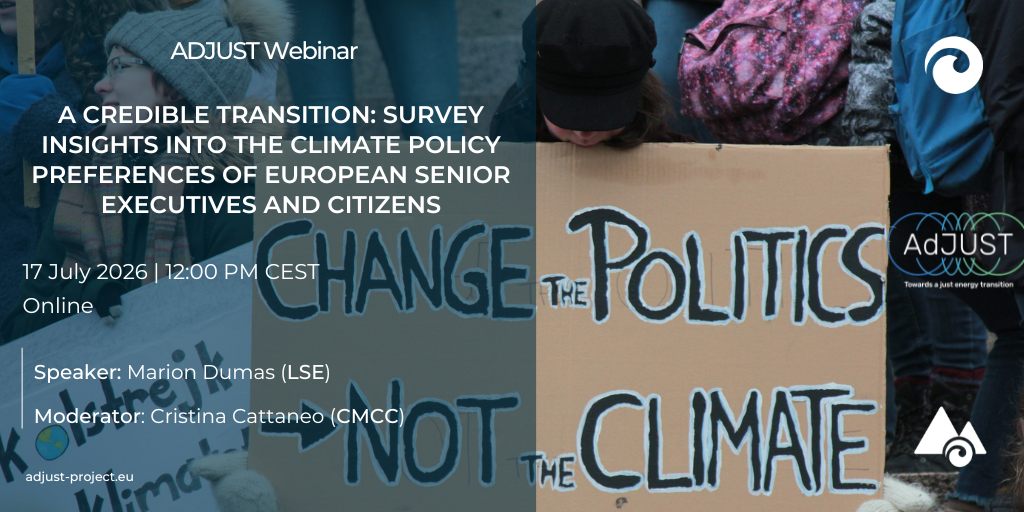
Speaker: Marion Dumas, LSE
Moderator: Cristina Cattaneo, CMCC
A central theme of AdJUST project is the question of institutional credibility: whether households and firms believe that public bodies are able and willing to deliver on the long-term commitments of a just transition.
In this webinar, we present results from a survey of citizens (in Germany, Spain, France, Romania) and a survey of senior executives in carbon intensive sectors (same countries plus the UK). We describe two innovative survey designs that allow us to take a broader view of climate policy preferences than past surveys. As we move to the results, a surprisingly simple common finding emerges across the nine surveys: people prefer a transition that seems to them credible. Our results counter the narrative of climate backlash. We find that business executives want stability and coherent investments. Meanwhile, citizens need explanations that help them understand that policies are fair and effective, and they need confidence that there is a credible investment pathway.
Marion Dumas is an Associate Professor at the Grantham Research Institute on Climate Change and the Environment at the LSE. She teaches climate policy in LSE’s School of Public Policy and is a co-I in the AdJUST Horizon Europe project. Her research focuses on the development and spread of green innovations, the political economy of the transition, and the capacities that public institutions need to successfully decarbonise.
AdJUST is a Horizon Europe project coordinated by the CMCC Foundation and carried out by a transdisciplinary European consortium consisting of 9 EU partners, 2 UK associated partners and other 11 EU associated partners. The objectives of AdJUST are to achieve a step change in societal understanding of the distributive repercussions of the transition to climate neutrality, and to identify effective and actively-supported policy interventions to accompany climate action so that no-one is left behind.