



FERS Summer School
20-25 July 2026 | Villa Vigoni – Menaggio (CO), Lake Como
More information
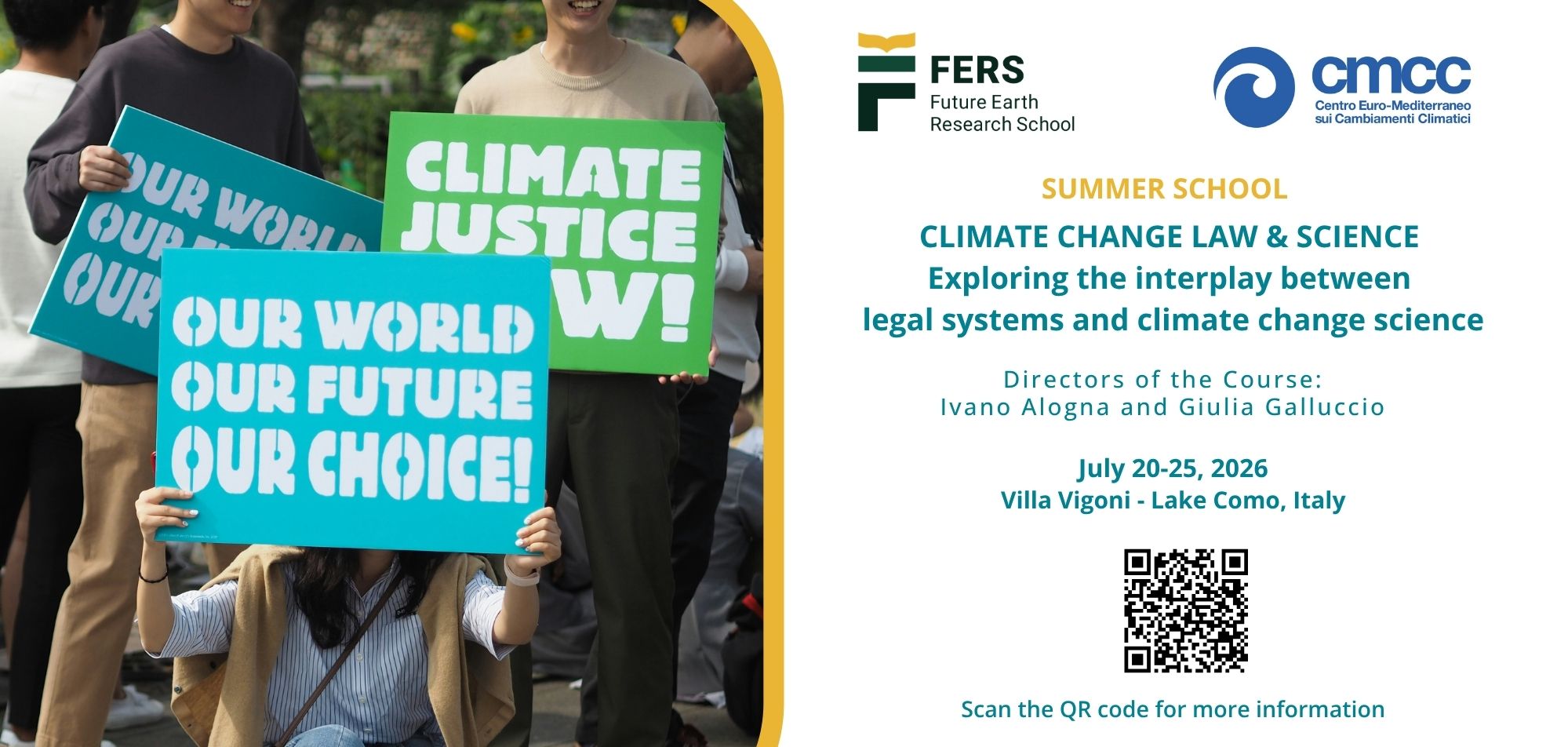
Climate change poses unprecedented challenges to legal systems, governance structures, and the production and use of scientific knowledge. As these challenges cut across traditional disciplinary boundaries, addressing climate change requires sustained interdisciplinary dialogue between legal scholarship and climate science.
This summer school offers an in-depth, research-focused exploration of the evolving relationship between climate change law and climate science. The course examines how scientific knowledge is generated, assessed, and translated into legal reasoning, regulatory frameworks, and litigation strategies.
20-25 July, 2026 – Villa Vigoni, Menaggio (CO), Lake Como, Italy
Number of participants: 20
Registration fee: €1950.00 (VAT not included; +22% VAT)
Application form
Course details
The Summer School on “Climate Law & Science: Exploring the interplay between legal systems and climate change science” is designed for participants seeking to strengthen their ability to engage with climate-related legal and policy challenges in academic, institutional, or professional contexts.
The course examines how scientific knowledge is generated, assessed, and translated into legal reasoning, regulatory frameworks, and litigation strategies. Through expert lectures, testimonies, interactive discussions, and hands-on workshops, participants will critically engage with the law–science interface and reflect on emerging governance challenges, including the role of courts and the implications of new scientific developments for specific accountability and broader climate governance.
The course will examine the following subjects.
- Production and Assessment of Climate Science: the processes through which climate knowledge is generated, including scientific methods, modelling tools and assessment frameworks. This topic also considers the current state of climate science and the role of uncertainty in projecting future climate scenarios.
- The role of scientific evidence in Law and Policy: how scientific knowledge is integrated into regulatory instruments, decision-making processes and policy responses at international, regional and domestic levels.
- Use of Scientific Evidence in Legal and Regulatory Contexts: the ways in which legal and regulatory institutions interpret and apply climate-related scientific knowledge, with particular attention to evidentiary standards, accountability mechanisms, and climate litigation. Participants will also explore the principles of climate change law under conditions of scientific uncertainty.
- Climate Litigation, Attribution, and Causation: the role of climate science in climate litigation, particularly regarding causation, standards of proof and evidentiary challenges. Participants will analyze the interaction between climate science – especially attribution science – and legal systems, focusing on how scientific findings are used to establish responsibility and causation within evolving frameworks of climate governance. The main approaches, actors and remedies of climate litigation will also be covered.
Learning outcomes
By the end of the course, participants will be able to:
- critically understand and explain how climate science is produced, assessed and communicated, including the roles of scientific methods, modelling tools and assessment frameworks.
- understand the relationship between law and science, and explain how climate science informs legal norms, regulatory frameworks, and decision-making processes.
- recognise and integrate climate-related scientific evidence into legal strategies, policy development, and regulatory compliance.
- analyse litigation and accountability frameworks by examining climate litigation cases, assessing enforcement mechanisms and anticipating how scientific developments can shape future legal risks and accountability.
- develop interdisciplinary problem-solving skills by critically assessing complex, real-world climate scenarios, proposing evidence-based legal solutions, and navigating the interaction between law and science.
Final output and assignment
Students will be invited to contribute to a collective publication designed to advance interdisciplinary understanding of the intersection between climate law and climate science.
During the programme, participants will work in small groups on selected thematic areas, such as attribution science and causation, evidentiary challenges in climate litigation, regulatory responses or corporate accountability, which will form the basis of short written outputs developed throughout and after the summer school.
A selection of these contributions will be refined further and integrated into an open-access collective publication, which aims to showcase the emerging interdisciplinary perspectives of early-career researchers and bridge the gap between academic research and policy-relevant insights. The publication will also contribute to the ongoing debate on the role of science in climate law and litigation.
Faculty
Ivano Alogna – Director of the Course
Dr Ivano Alogna is Senior Research Fellow in Environmental and Climate Change Law at the British Institute of International and Comparative Law (London), where he leads the programme in this field. He is also Senior Associate Scientist at the CMCC Foundation, working at the intersection of climate science and law. He is Co-Lead of the Climate Litigation Cluster within the IUCN World Commission on Environmental Law (WCEL) and Adjunct Professor at leading European universities, including Sorbonne Law School and Bologna Business School. He is a qualified lawyer at the Milan Bar. He has co-edited leading volumes in the field, including Climate Change Litigation: Global Perspectives (Brill, 2021) and Climate Change Litigation in Europe (Intersentia, 2024). His PhD thesis, La circulation des modèles juridiques dans le domaine de l’environnement (University Paris 1 Panthéon-Sorbonne), awarded the Special Jury Prize of the French Society of Environmental Law (SFDE), is published by LGDJ (2026).
Giulia Galluccio – Director of the Course
Giulia Galluccio holds a degree in Business Administration from Bocconi University and a PhD in Science and Management of Climate Change from Cà Foscari University of Venice. She is Director of the Future Earth Research School and Director of CMCC Advanced Training and Education Center. She is a science policy analyst working at the interface of science, policy and society. She is currently Vice-Chair of the European Joint Initiative on Connecting Climate Knowledge for Europe, a pan-European intergovernmental initiative that brings together European countries to jointly coordinate climate research and fund new transnational research initiatives.
Elisa Fiorini Beckhauser
Elisa is a Postdoctoral Researcher at the Euro-Mediterranean Center on Climate Change (CMCC Foundation), holds a Ph.D. in Law and Sustainability from the University of Salento (Italy), and obtained a Bachelor’s degree in Law from the Federal University of Santa Catarina (Brazil). She was a researcher in the Environmental Law and Political Ecology in the Risk Society Research Group, served as Co-Coordinator of the Latin American Observatory on Human Mobility, Climate Change, and Disasters, and was Co-Lead of the World Commission on Environmental Law Early Career Specialist Group in the project “Next-Generation Environmental Law Research.”. She is currently the Lead of the project “Sea Legal Rise I and II” at the Environmental Justice and Ecological Transition Law Clinic at Sciences Po Paris. She is also a member of the Latin American Climate Lawyers Initiative for Mobilizing Action (LACLIMA) and the Global Network for Human Rights and the Environment (GNHRE), and serves as an Expert in the Harmony with Nature Network of the United Nations in the Young Professionals category in Earth-Centered Law.
Giovanni Conti
Dr. Giovanni Conti graduated cum laude with a Master’s in Theoretical Physics from the University of Parma in 2011 and earned his Ph.D. in 2016 from Ca’ Foscari University of Venice, specializing in the Science and Management of Climate Change with a focus on Dynamic Climatology. Following three and a half years as a postdoctoral researcher at Hamburg University, where he worked on chaotic advection, turbulence, and passive tracer dynamics, he joined the CMCC in 2020. Dr. Conti’s research spans a range of topics, including the study of climate phenomena such as ENSO, employing advanced techniques like Path Integrals, Transition Matrices, and the Fokker-Planck equation. His expertise also covers chaotic advection, turbulence, point vortex dynamics, and data assimilation. Currently a Junior Scientist at CMCC, Dr. Conti is focused on developing an atmospheric data assimilation system and investigating the biases that impact seasonal forecast simulations.
Logistical information
1. Location
The course will take place at Villa Vigoni. Villa Vigoni is located above Menaggio, on Lake Como (address: Via Giulio Vigoni, 1, 22017 Menaggio CO). Menaggio is a charming town located on the western shore of Lake Como, facing the picturesque village of Varenna. With its beautiful lakeside promenade, historic center and surrounding mountains, it is a popular destination for visitors exploring the central part of the lake.
From the town center, please allow approximately 15 minutes walking time (uphill/downhill).
2. Food and Accommodation
The accommodation will be at Villa Vigoni. Please remember that in-person participation is mandatory.
The school will provide breakfast, lunch, and dinner for all participants during the course. However, participants may choose to make their own arrangements at their own expense, provided they give prior notice. The school will not cover any additional costs.
3. Transport
Nearest airports: Milano Malpensa (MXP), Milano Linate (LIN), Milano Bergamo Orio al Serio (BGY) airports .
Nearest train stations: Varenna-Esino (linked to Menaggio by ferryboat), Como San Giovanni and Como Lago train stations (linked to Menaggio by bus).
For more information on how to get to Villa Vigoni, please refer to this link.
Given that most participants will travel via Milan, the school will organize a shuttle service from Milan to Villa Vigoni. More details will be provided to selected candidates.
Fees and financial assistance
The course fee is €1950 per person. A 22% VAT will have to be added to the course fee, unless you fall under an exempt category.
The course fee includes accommodation and meals during the course delivery, access to all course activities, and transfers from the designated meeting point to the course venue and back on the first and last day of the course.
A 15% discount is available for FERS School Alumni (participants from the past two years.
The School will NOT cover any additional costs not explicitly mentioned above, including but not limited to visa application fees or related expenses, medical or travel insurance, and travel arrangements to and from the meeting point or course venue, regardless of the point of departure. Aside from the two transfers mentioned above (to and from the course venue), no additional transfers will be organized.
The School offers limited financial assistance covering the course fee and the services included therein.
We are committed to fostering inclusion and equal opportunities. Financial assistance is available to participants who may otherwise face barriers to accessing the course.
To apply, applicants must include a statement in the motivation letter within the application form, explaining why they should be considered for financial assistance. Grants are awarded by the Future Earth Research School based on the information provided and the overall application. Meeting the eligibility criteria or expressing interest does not guarantee the award of financial assistance.
All applicants will be notified upon completion of the selection process. Successful candidates will receive a confirmation email from [email protected]. Where granted, financial assistance will be explicitly stated in the notification.
The decision of the selection committee is final and not subject to appeal. The School is unable to provide individual feedback on applications and reserves the right not to award financial assistance.
Requirements
Our courses are designed for students, early-career researchers and professionals.
The Summer School is mainly geared towards Master’s, Ph.D. students, postdocs and early-career researchers and professionals in relevant fields. The maximum age at the time of application is 40 years old.
This initiative is part of the Future Earth Research School (FERS), an international school entirely focused on environmental sustainability and climate change coordinated by CMCC Foundation, Advanced Training and Education Center (ATEC). FERS will offer a strategic overview on how to model our climate system and deal with future global challenges, building a fertile ground for innovation and new research pathways.