



Sustainable Coastal Growth and Resilience
23 July 2026, 13.00 – 15.00 CEST | Online
More information and registration
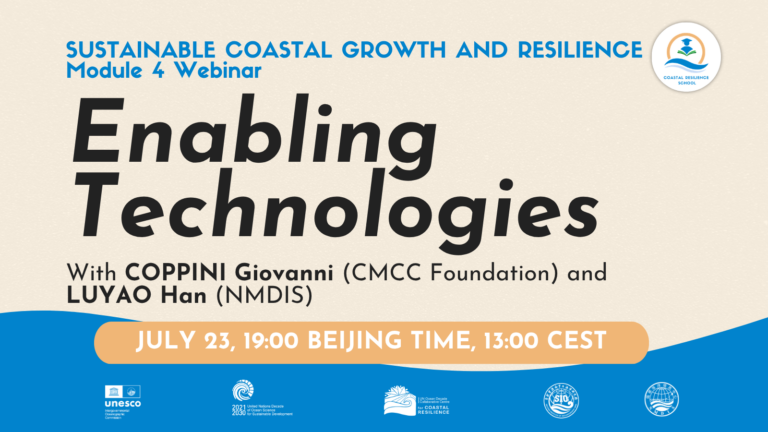
As part of the second edition of the Sustainable Coastal Growth and Resilience (Co-Growth) course and with the participation of Giovanni Coppini from CMCC as speaker, the Module 4 explores the role of enabling technologies in strengthening coastal resilience, with a focus on artificial intelligence, cloud computing, Digital Twins, and marine big data. Through contributions from experts at CMCC Foundation and the National Marine Data and Information Service (NMDIS), the session highlighted innovative approaches to coastal monitoring, disaster prevention, and decision support, showcasing how advanced digital technologies can improve climate adaptation and resilience in vulnerable coastal areas.
Speakers and abstracts of the session:
Title: AI and Cloud-Based Solutions for Coastal Resilience
Speaker 1: Giovanni Coppini
Short abstract: This contribution examines how cloud-native applications and workflows powered by AI can strengthen coastal resilience by integrating heterogeneous coastal observations, numerical models, data analytics. It discusses scalable approaches for Digital Twins of the Coastal Ocean, what-if scenarios and decision support, transforming fragmented coastal data into operational knowledge for risk reduction and adaptation.
Tentative title: Exploration and practice of applying DeepSeek to marine disaster prevention and control along China’s coast
Speaker 2: Ms. Han Luyao
Short abstract: DeepSeek-R1, a large language model developed by DeepSeek featuring high efficiency, low cost, and high transparency, offers new approaches for marine disaster prevention and control in China’s coastal areas, which are threatened by storm surges, tsunamis, ocean waves, and red tides. In disaster monitoring and forecasting, the model integrates multi-source heterogeneous data to build high-precision prediction models. For risk assessment and strategy formulation, it enables quantitative risk evaluation and generates tailored prevention plans. In emergency response and post-disaster recovery, it dynamically produces rescue and recovery plans.