



UPTAKE Webinar
14 October 2026, h. 14:00 CEST
To join the webinar, register here
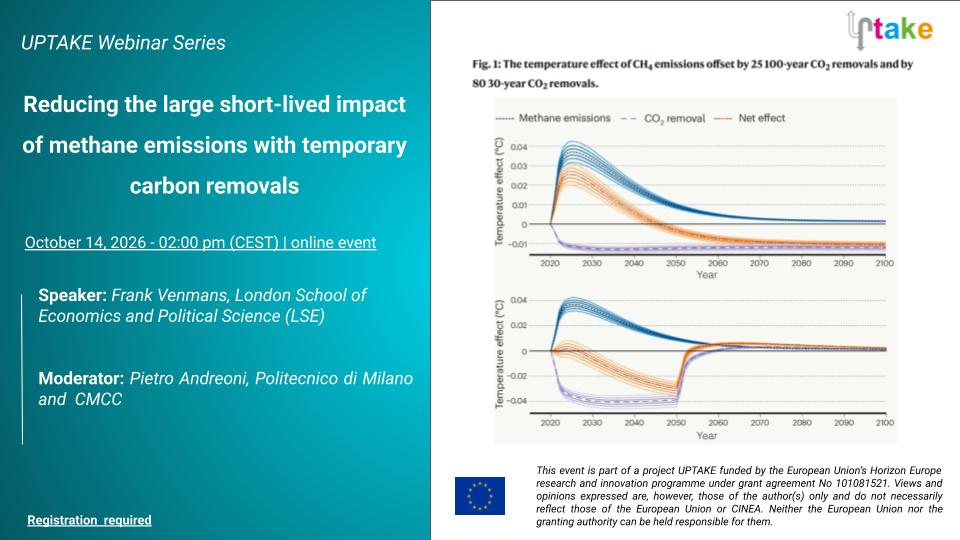
The UPTAKE monthly webinar series returns, continuing its engaging discussions on carbon dioxide removal (CDR) technologies and the latest research developments. The next session in the series, dedicated to recent publications on CDR research, will focus on the paper Temporary carbon dioxide removals to offset methane emissions
Speaker: Frank Venmans, Grantham Institute on Climate Change at The London School of Economics and Political Science (LSE)
Moderator: Pietro Andreoni, CMCC Foundation and Politecnico di Milano
Methane has a much larger short-term warming effect than CO2, even though CO2’s effect is smaller but far more persistent over time. This paper argues that offsetting methane emissions with temporary, time-matched CO2 removals, rather than with permanent removals calibrated to an arbitrary time horizon, avoids unfairly transferring climate damages between generations. Using a welfare-based equivalence approach, the authors estimate that around 87 one-tonne, 30-year temporary CO2 removals are needed to offset the damages caused by 1 tonne of methane, and show this ratio stays fairly stable regardless of the discount rate, damage assumptions, or emissions scenario used. They conclude that 20–30 year monitoring periods for nature-based removal projects are more credible and easier to enforce than long-term commitments, offering a practical route for integrating temporary CO2 removal into methane-offset strategies.
ORGANIZED BY:
The Industrial & Planetary Carbon Cycle Program at CMCC as part of the UPTAKE project. Coordinated by CMCC, UPTAKE seeks to support the sustainable expansion of CDR methods by developing reliable strategies through technical, theoretical, and practical analysis—plus interactive dialogue within a dedicated stakeholder forum.
UPTAKE is an EU-funded research project on CDR methods and knowledge coordinated by CMCC Foundation (EIEE Institute).