



London Climate Action Week 2026
24 June, 10:00 AM – 12:00 PM BST (UTC+1) | London, King’s College London, King’s Building – St David’s Room (level 2), Strand Campus, WC2R 2LS and Online
Watch the video and discover more
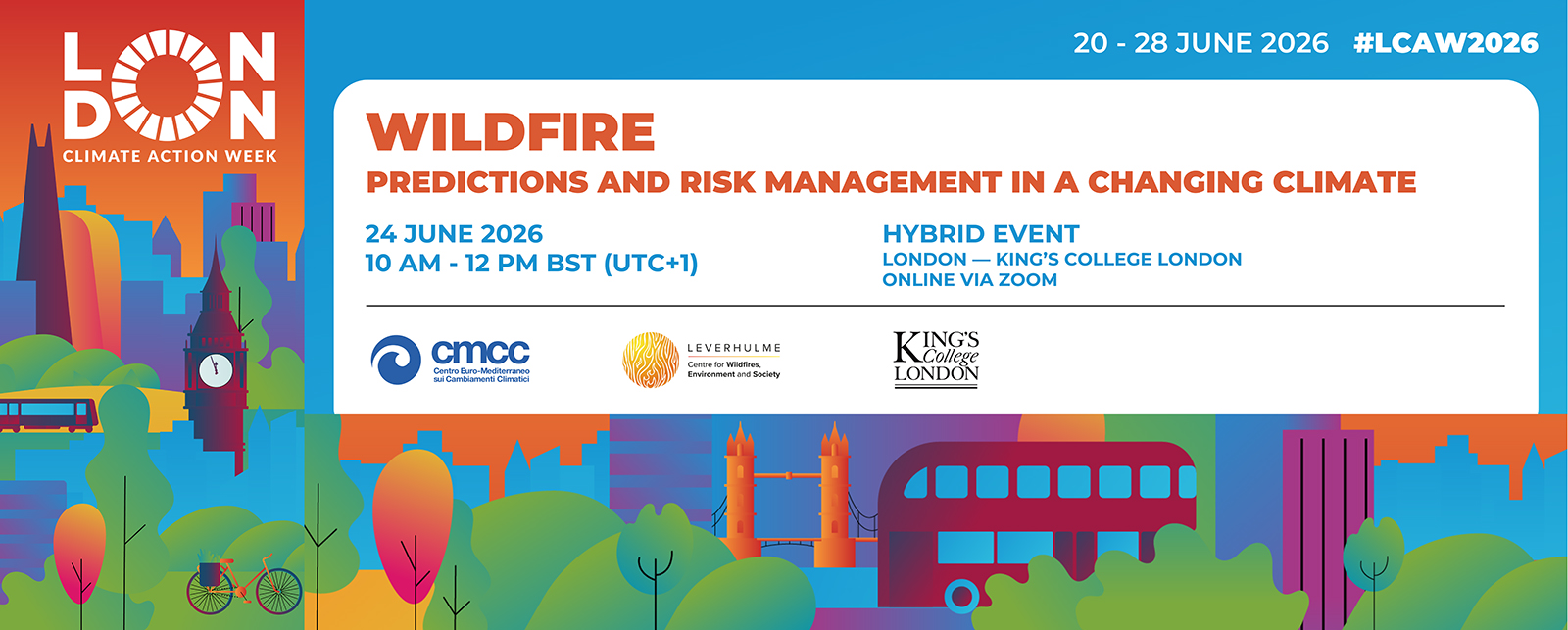
Wildfire predictions and risk management in a changing climate
From emerging technologies to informed decisions: Linking frontier science, technology and policy for addressing wildfire risk.
From the Mediterranean to the Arctic, fires are growing in frequency, intensity and duration, with far-reaching impacts on ecosystems, health and economies.
In response to increasingly urgent challenges, advances in science and technology are changing how we understand and manage evolving fire risks. From Artificial Intelligence tools that help anticipate fires, to improved systems for tracking their impact on the global carbon cycle, researchers are developing new ways to support better decisions and more effective risk management.
This event will examine emerging evidence, technological innovation, and the broader implications of wildfire activity across climate, ecosystems, and society, bringing together researchers working at the forefront of fire science, risk analysis, and climate governance to explore the latest advances in responding to fires in a warming world.
Designed to foster dialogue across disciplines and sectors, the event will engage scientists, policymakers, practitioners, and the general public. It aims to provide participants with a clearer understanding of evolving wildfire risks, the latest analytical and predictive tools, and how research can inform effective governance and climate action worldwide.
WATCH THE VIDEO
AGENDA:
PART I – From observation to prediction
Chair: Adriana Ford, Leverhulme Wildfires Center
MONITORING & MODELING / Wildfires, carbon and forest resilience
Wildfires in the global carbon budget
Manuela Balzarolo, Euro-Mediterranean Center on Climate Change (CMCC)
Exploring stochastic forest futures under climate change, disturbance, and management
Hyun-Woo Jo, International Institute for Applied Systems Analysis (IIASA)
PREDICTION / Advances in Artificial Intelligence and Machine Learning for fire-risk forecasting
Machine Learning for wildfire forecasting
Shahbaz Nihal Ahmed Alvi, Euro-Mediterranean Center on Climate Change (CMCC)
New multi-source and multi-modal data-driven models for detection and spread forecasting
Andrew Clelland and Sina Mehrdad, Imperial College London and Leverhulme Centre for Wildfires (LWC)
Q&A session
Break
PART II – From Impacts to Action
Chair: Cecilia Keating, Carbon Brief
EVOLVING IMPACTS / Fire dynamics in the Arctic and boreal regions
Arctic wildfires impact on the carbon cycle
Soheil Shayegh, Euro-Mediterranean Center on Climate Change (CMCC)
Increasing risks of fire-induced metal exposure for the public and firefighters
Luke Richardson-Foulger, King’s College London and Leverhulme Centre for Wildfires (LWC)
GOVERNANCE & MANAGEMENT / Approaches to wildfire risk management
Fire governance: Integration across space, time and values
Kate Schreckenberg, King’s College London and Leverhulme Centre for Wildfires (LWC)
Towards fire-resilient landscapes; local action for wildfire prevention
Rosalien Jezeer, Tropenbos International
Q&A session
Organizers:
CMCC – Euro-Mediterranean Center on Climate Change – is a non-profit, international and multidisciplinary research center that produces advanced knowledge on the effects of climate change and how we can make natural systems, economies, and societies more resilient. Bringing together cutting-edge climate modelling, impact assessment, and economics, CMCC delivers climate insight for global impacts.
The Leverhulme Centre for Wildfires, Environment and Society – is collaboration between Imperial College London, King’s College London, the University of Reading, and Royal Holloway, University of London, funded by the Leverhulme Trust from 2019-2029. The Center’s aim is to radically transform the scientific and practical understanding of wildfire, so that society can understand, predict and manage wildfire more effectively in the future.