



UPTAKE Webinar
09 December 2026, h. 14:00 CET
To join the webinar, register here
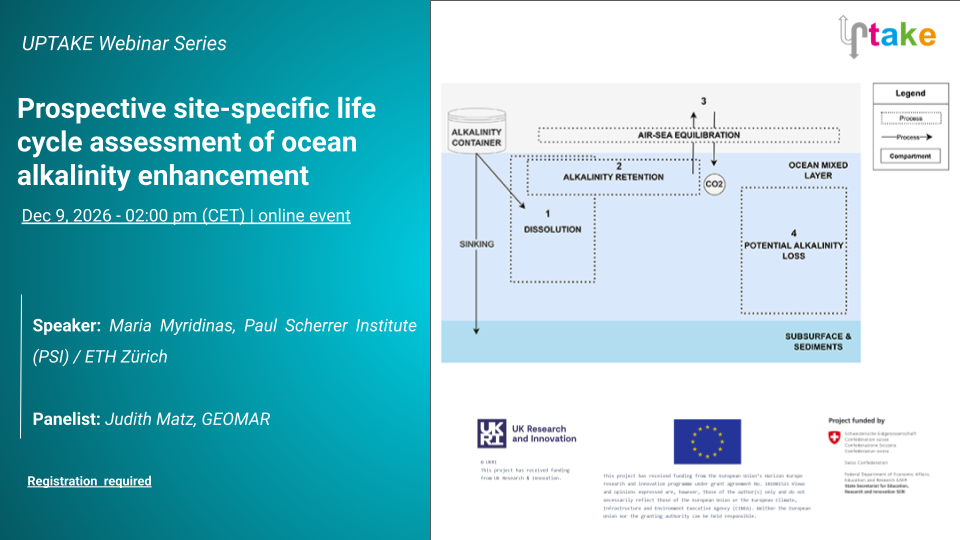
The UPTAKE monthly webinar series returns, continuing its engaging discussions on carbon dioxide removal (CDR) technologies and the latest research developments. The next session in the series, dedicated to recent publications on CDR research, will focus on the paper Prospective site-specific life cycle assessment of ocean alkalinity enhancement.
Speaker: Maria Myridinas, PSI, ETH Zürich
Panelist: Judith Matz, GEOMAR Helmholtz Centre for Ocean Research Kiel
About the paper:
Ocean alkalinity enhancement (OAE) is a promising marine carbon dioxide removal (CDR) option, but its net climate benefit and wider environmental implications depend strongly on where, and how it is implemented as well as on decarbonized energy and material supply chains.
We develop a prospective, site-specific, life cycle assessment (pLCA) that couples a field trials’ validated high-resolution ocean biogeochemical model with life cycle assessment for five OAE pathways deployed via wastewater outfalls in Halifax Harbor, Canada: three on magnesium hydroxide (two from serpentinite, via ammonium sulfate (AS) and HCl leaching (HCl), one from bischofite brine (BIS)) and two on sodium hydroxide (from industrial-grade sodium chloride (NaOHs) and seawater desalination brine hydroxide (NaOHb)). Using the functional unit of removing and permanently storing 1 t of atmospheric CO₂, we compare present-day conditions with a 2050 scenario and quantify eighteen ReCiPe 2016 midpoint impacts.
Present-day results show little to no net climate benefit: net climate effects range from −0.09 to +0.71 t CO2-equivalent (CO2e) per t CO₂ removed, with fossil electricity and heat supply dominating the impact. By 2050, all pathways are net removers with uptake efficiencies of 81%–95% as energy supply decarbonizes. BIS performs best in sixteen of eighteen impact categories, whereas NaOHs and AS are consistently worst across most categories. As energy decarbonizes, burdens shift from fossil fuel combustion to materials, metals, and related mining (especially copper), chemicals, and biofuels production for feedstock transport.
The analysis shows that robust OAE assessment requires site-specific CO₂ uptake efficiencies, prospective supply-chain representation, and multi-criteria evaluation rather than focusing only on net CO₂ removal, because climate-attractive pathways can carry substantial burdens in (eco)toxicity, resource depletion, or other impact categories. The proposed coupling of a validated regional ocean model with pLCA provides a transferable template to evaluate OAE and other marine CDR options in CDR portfolios.
ORGANIZED BY:
The Industrial & Planetary Carbon Cycle Program at CMCC as part of the UPTAKE project. Coordinated by CMCC, UPTAKE seeks to support the sustainable expansion of CDR methods by developing reliable strategies through technical, theoretical, and practical analysis—plus interactive dialogue within a dedicated stakeholder forum.
UPTAKE is an EU-funded research project on CDR methods and knowledge coordinated by CMCC Foundation (EIEE Institute).