



International Conference
10–12 June 2026 | Milano, Politecnico di Milano
More information
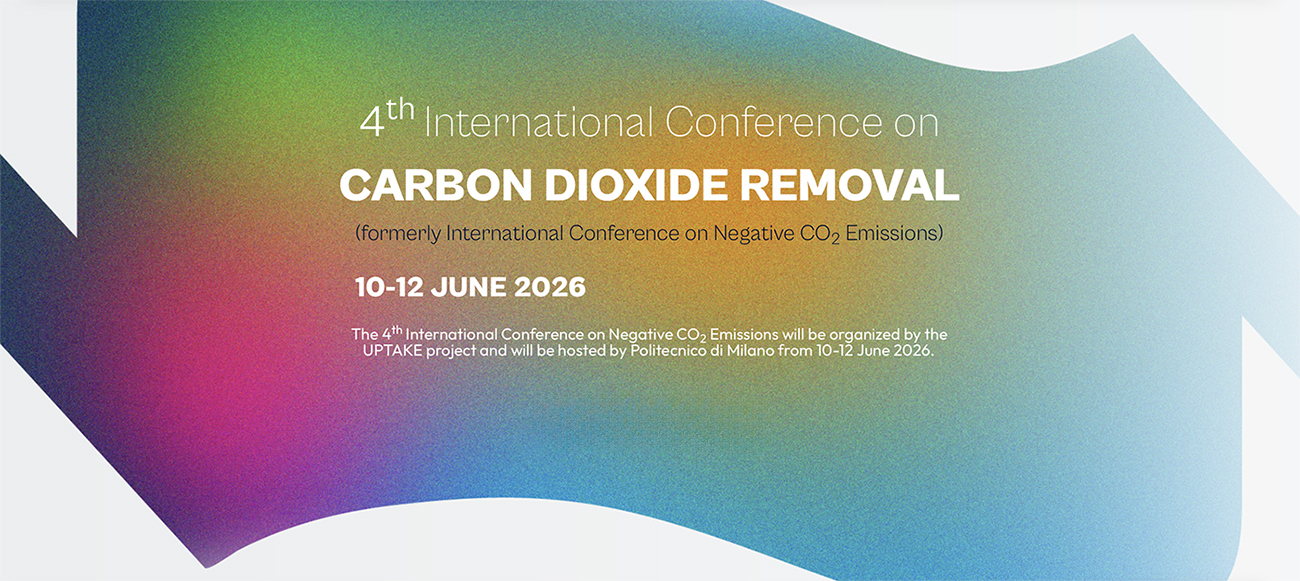
The CMCC Foundation, as the coordinator of the UPTAKE project, and Politecnico di Milano will be hosting the 4th International Conference on Carbon Dioxide Removal (formerly the International Conference on Negative CO₂ Emissions) on June 10–12, 2026 at Politecnico di Milano, Milan, Italy.
The event aims to highlight the latest scientific developments in the field of Carbon Dioxide Removal (CDR). It offers a valuable opportunity to contribute to the global dialogue on the topic and discuss the latest scientific findings and innovations in this field with a broad community of stakeholders.
The conference is the fourth in a series of events aimed at addressing the rapidly increasing importance of Carbon Dioxide Removal (CDR) in climate research and in meeting climate targets. The first two conferences in this series were conceived and held at Chalmers University of Technology, in Gothenburg, Sweden and the last edition was organized by the CO2RE – The Greenhouse Gas Removal Hub in Oxford, UK.
The event brings together scientists and experts across a wide range of disciplines and research topics – including science and engineering, policy, economics and public perceptions – to forge connections and to create a platform for wider discussion of the role of CDR in climate action and sustainable development.
Conference Themes include:
- Fundamental science and technology. Developments in understanding the fundamental processes of physics, chemistry and biology underpinning CDR strategies.
- Policy, economics and upscaling. Analysis of emerging and potential policies to incentivise, regulate or accelerate innovation and upscaling of CDR and the costs and benefits of such interventions. The focus can be at international, regional or national levels, or can be at sub-national scales for cases of particular wider relevance.
- Advances in Measurement, Reporting and Verification. New techniques and protocols for robust and transparent measurement, reporting and verification (MRV) of CDR. The focus is on the use of novel techniques combining AI and EO with other conventional methods that can be on project-level MRV, or at the level of national or organisation-level inventories.
- Lifecycle assessment, techno-economic assessment and system integration. Assessment of the performance of CDR strategies across the lifecycle and supply chains of technologies and projects. Insights into the interaction of CDR with energy, industrial and land systems, particularly within comprehensive climate change mitigation pathways, through integrated assessment modelling or other analytical techniques.
- Climate system effects of net-negative emissions. Assessment of the physical climate system feedback and response to net-negative emissions, the climate implications of impermanent removals, and climate impacts (ir)reversibility.
- CDR scenarios and temperature overshoot. Evaluation of the role and effectiveness of CDR approaches in net-zero and net-negative emissions scenarios, including levels of achievable CDR, residual emissions, and the implications for near-term decision-making.
- Pathways for CDR uptake. Potential mechanisms for enabling CDR deployment beyond carbon market systems including potential co-benefits, additionalities, and spillovers from other sectors and technologies.
- CDR interaction with broader mitigation strategies and adaptation. Analysis of synergies and trade-offs of negative emissions with levels of residual emissions, sectoral decarbonization, and adaptation strategies.
- Justice, ethics, and social perceptions of CDR. Considerations of different dimensions of CDR justice (distributive, procedural, informational, recognitional, interactional, etc.), ethics, and understanding of public attitudes towards CDR.
- Removal of non CO2 gases. Mechanisms for the removal of non-CO2 greenhouse gases, such as methane and nitrous oxide.
The event is organized by the CMCC Foundation – Euro-Mediterranean Center on Climate Change, as the coordinator of the UPTAKE project, and Politecnico di Milano.
About the CMCC Foundation
The Euro-Mediterranean Center on Climate Change (CMCC) is a leading research institution dedicated to climate science, providing cutting-edge insights and innovative solutions for climate adaptation and mitigation strategies. CMCC plays a pivotal role in global climate research, working closely with international partners to advance climate modeling, forecasting, and policy recommendations.
The 4th International Conference on Carbon Dioxide Removal (formerly the International Conference on Negative CO₂ Emissions) is organized by one of CMCC’s Institutes – the European Institute on Economics and the Environment, and is in line with the CMCC strategic program on Integrating Industrial & Planetary Carbon Cycle.
The European Institute on Economics and the Environment delves deep into the evaluation of strategies towards net-zero emissions and beyond, the quantitative analysis of the socio-economic ramifications of environmental and climatic hazards, and the frameworks to evaluate and inform policy design to promote environmental and social sustainability.
The Integration of the planetary biogeochemical and industrial Carbon Cycle Program is one of four strategic research programs within CMCC, focusing on understanding and shaping the new paradigm of building a net-zero carbon economy, which is essential to providing quantitative and narrative analyses of socio-economic systems in the context of a sustainable and resilient future.
About the UPTAKE project
UPTAKE is a research project, coordinated by the Foundation CMCC, that aims to develop resilient CDR strategies based on strengthened scientific evidence on the social, technological, economic, and environmental characteristics of CDR technologies and their interplay.
UPTAKE is funded by the European Union’s Horizon Europe research and innovation programme under grant agreement No. 101081521.
About Politecnico di Milano
Since 1863, Italy’s largest science and technology university, the Politecnico di Milano, has combined scientific rigor with creativity. With over 160 years of history, the university has embodied technology, creativity, dedication, courage, initiative, and enthusiasm. Politecnico di Milano is the emotion of discovery, the wonder of success, the ability to look to the future. A past that gathers innovation and beauty. A present that opens to new challenges.
For more information on the event and how to take part in it, visit the conference website