



2013
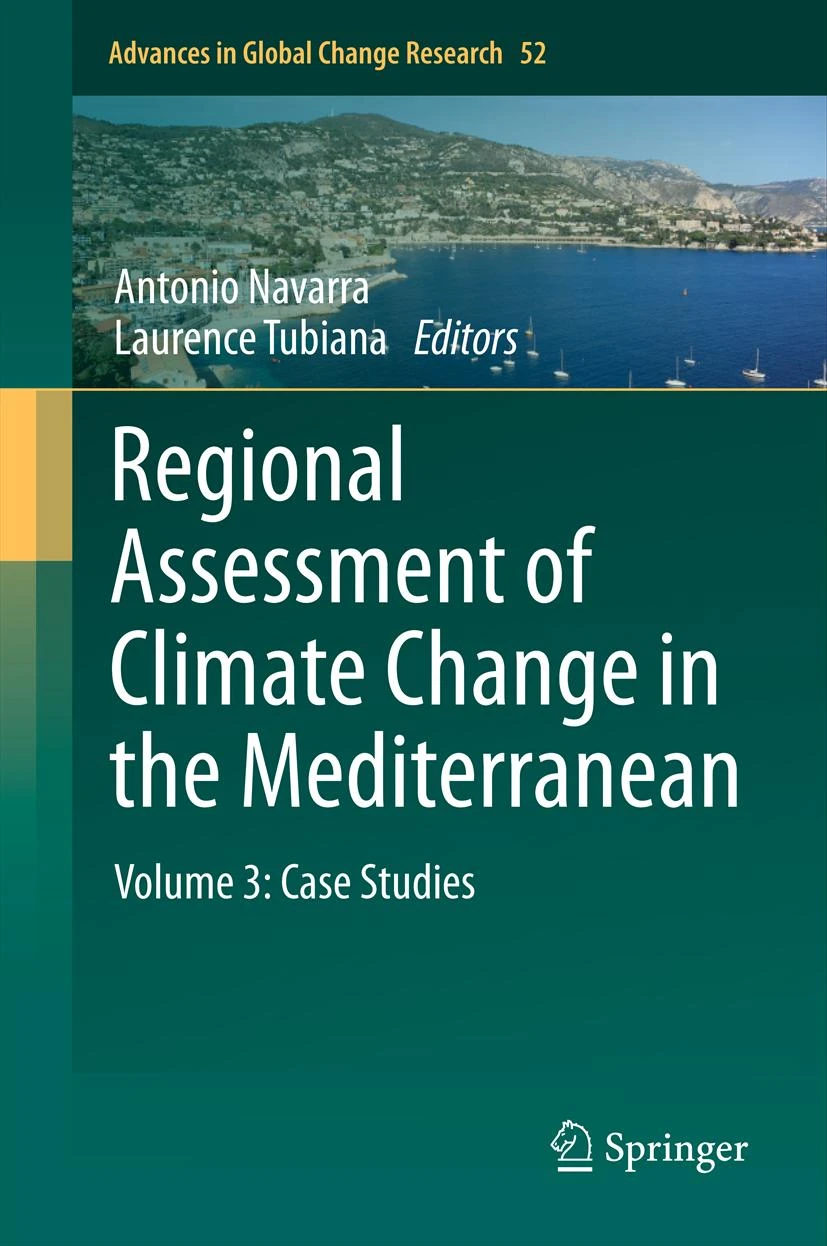
Regional Assessment of Climate Change in the Mediterranean
Volume 3: Case Studies
Editors: Antonio Navarra – CMCC President, Laurence Tubiana
This is the third volume of a three-volume final report, which thoroughly describes, synthesizes and analyzes the results of the four-year Integrated Research Project CIRCE – Climate Change and Impact Research: Mediterranean Environment, funded by the EU 6th Framework Programme. Conducted under the auspices of the National Institute of Geophysics and Volcanology in Rome, Italy, the study was designed to predict and to quantify the physical impacts of climate change in the Mediterranean, and to assess the most influential consequences for the population of the region.
Explore the other volumes in the CIRCE series.
Volume 1
Volume 2
Chapter
Introduction
Authors: Agnew M.D., Goodess C.M., Hemming D., Giannakopoulos C., Ben Salem S., Bindi M., Bradai M.N., Congedi L. (CMCC), Dibari C., El-Askary H., El-Fadel M., Ferrise R., Grünzweig J.M., Harzallah A., Hattour A., Hatzaki M., Kanas D., Kostopoulou E., Lionello P. (CMCC), Oweis T., Pino C., Reale M., Sánchez-Arcilla A., Senouci M.
The heterogeneous nature of the Mediterranean environment, combined with a wide diversity of socio-economic and cultural identities, make this region particularly amenable to integrated research on climate change impacts, vulnerabilities, and adaptive response. Eleven case-study locations have been strategically selected to represent three generic Mediterranean environments (urban, rural and coastal). While each case study location comprises a unique and complex set of climate-related issues, the range and scope of the case studies allows identification of common lessons and messages for the wider Mediterranean region. The aim is to perform an integrated assessment of climate impacts, vulnerability and adaptation at a regional to local scale. A risk-based ‘bottom up’ approach (based on regional stakeholder dialogue) is combined with a ‘top down’ case-study indicator assessment focused on a common conceptual and methodological framework.
Chapter
Stakeholders
Authors: Agnew M.D., Goodess C.M., Hemming D., Giannakopoulos C., Bindi M., Dibari C., El-Askary H., El-Hattab M., El-Raey M., Ferrise R., Harzallah A., Hatzaki M., Kostopoulou E., Lionello P. (CMCC), Abed S.S., Sánchez-Arcilla A., Senouci M., Sommer R., Taleb M.Z., Tanzarella A.
The active participation of the stakeholder community is viewed as a crucial consideration in the regional assessment of climate change in the Mediterranean. Each of the CIRCE integrating case studies has benefitted from the real-life experience and expertise of local and regional stakeholders. The level of involvement has included stakeholder dialogue on an informal basis throughout the project, culminating in a series of more formal regional stakeholder workshops in the final year of the project. For each case study, stakeholders were chosen from the arena for which decisions are made at the regional-to-local level, and comprise local and regional decision and policy makers within government departments, agencies, and public/private sector entities. Regional stakeholders have contributed to the case-study assessments in six key areas: the conceptual framework and indicator selection, data and knowledge, identification of climate impact thresholds, risk assessment and management, strategies for adaptation, and guidance for policy. However, impediments to stakeholder participation have also been highlighted and include lack of motivation and resources commitment, stakeholder fatigue, and a need for targeted information. The CIRCE experience suggests that a more participatory approach, which involves sharing of ‘best’ practice and accessible targeted information, will be fundamental to successful adaptation planning in the Mediterranean region. This experience has also been used to develop a good practice checklist for facilitating stakeholder involvement in research projects.
Chapter
Physical and Socio-economic Indicators
Authors: Agnew M.D., Goodess C.M., Hemming D., Giannakopoulos C., Ben Salem S., Bindi M., Bradai M.N., Dibari C., El-Askary H., El-Fadel M., El-Raey M., Ferrise R., Grünzweig J.M., Harzallah A., Hattour A., Hatzaki M., Kanas D., Kostopoulou E., Lionello P. (CMCC), Oweis T., Pino C., Psiloglou B., Abed S.S., Sánchez-Arcilla A., Senouci M., Taleb M.Z., Tanzarella A.
A set of physical and social indicators relevant to each Mediterranean case study has been developed within the context of the CIRCE case studies integrating framework. This framework approach provides a systematic means of structuring indicator selection and helps to provide a scientific basis for the assessment of climate-related impacts and vulnerability. A detailed set of criteria was developed to select and refine indicators through an iterative process of review and consultation. Indicators represent key issues related to climate variability and change for each of the case-study locations. Seven key indicator themes are identified: climate and atmosphere; marine and coastal systems; terrestrial ecosystems and biodiversity; freshwater systems; agriculture and forestry; human health and well being; and, the economy. A number of core indicators are common to all case studies (for identifying common/disparate trends), others are common across generic case studies (urban, rural, coastal), and some are case-study specific. Data and methodological challenges in the indicator assessment included: data availability and quality limitations; distinguishing impacts from vulnerabilities, and climate from non-climate influences; and, identifying thresholds and coping ranges. Despite these difficulties, the selected set of indicators proved a useful and accessible tool for monitoring trends and portraying key information to regional stakeholders.
Chapter
Climate Impact Assessments
Authors: Hemming D., Agnew M.D., Goodess C.M., Giannakopoulos C., Ben Salem S., Bindi M., Bradai M.N., Congedi L. (CMCC), Dibari C., El-Askary H., El-Fadel M., El-Raey M., Ferrise R., Grünzweig J.M., Harzallah A., Hattour A., Hatzaki M., Kanas D., Lionello P. (CMCC), McCarthy M., Mösso Aranda C., Oweis T., Sierra J.P., Psiloglou B., Reale M., Sánchez-Arcilla A., Senouci M., Tanzarella A.
This chapter highlights key climate impacts, hazards and vulnerabilities and associated indicators that have been used to assess current (recent) climate impacts at each of the case-study sites. The aim is to illustrate some of the wide range of information available from individual case studies and highlight common themes that are evident across multiple case-study locations. This is used to demonstrate linkages and sensitivities between the specific climate impacts of relevance for each case-study type (urban, rural and coastal) and the key climate hazards and biogeophysical and social vulnerabilities representing the underlying drivers and site conditions. For some impacts, there are clear, direct links with climate events, such as heat stress and flooding, while for others, such as energy supply and demand, the causal relationships are more indirect, via a cascade of climate, social and economic influences. Water availability and extreme temperatures are common drivers of current climate impacts across all case studies, including, for example, freshwater supply and heat stress for urban populations; irrigation capacity and growing season length for agricultural regions; and saltwater intrusion of aquifers and tourist visitor numbers at coastal locations. At some individual case-study locations, specific impacts, hazards and/or vulnerabilities are observed, such as peri-urban fires in Greater Athens, infrastructure vulnerability to coastal flooding in Alexandria, groundwater levels in Tel Hadya and vector-borne diseases in the Gulf of Oran. Throughout this chapter, evidence of current climate impacts, hazards and vulnerabilities from each of the case studies is detailed and assessed relative to other case studies. This provides a foundation for considering the wider perspective of the Mediterranean region as a whole, and for providing a context from which to assess consequences of future climate projections and consider suitable adaptation options.
Chapter
Integration of the Climate Impact Assessments with Future Projections
Authors: Goodess C.M., Agnew M.D., Giannakopoulos C., Hemming D., Ben Salem S., Bindi M., Bradai M.N., Congedi L. (CMCC), Dibari C., El-Askary H., El-Fadel M., El-Raey M., Ferrise R., Founda D., Grünzweig J.M., Harzallah A., Hatzaki M., Kay G., Lionello P. (CMCC), Mösso Aranda C., Oweis T., Sierra J.P., Psiloglou B., Reale M., Sánchez-Arcilla A., Senouci M., Tanzarella A., Varotsos K.V.
Climate projections are essential in order to extend the case-study impacts and vulnerability assessments to encompass future climate change. Thus climate-model based indicators for the future (to 2050 and for the A1B emissions scenario) are presented for the climate and atmosphere theme (including indices of temperature and precipitation extreme events), together with biogeophysical and socioeconomic indicators encompassing the other case-study themes. For the latter, the specific examples presented here include peri-urban fires, air pollution, human health risks, energy demand, alien marine species and tourism (attractiveness and socio-economic consequences). The primary source of information about future climate is the set of global and regional model simulations performed as part of CIRCE. These have the main novel characteristic of incorporating a realistic representation of the Mediterranean Sea including coupling between sea and atmosphere. These projections are inevitably subject to uncertainties relating to unpredictability, model structural uncertainty and value uncertainty. These uncertainties are addressed by taking a multi-model approach, but problems remain, for example, due to a systematic cold bias in the CIRCE models. In the context of the case-study integrated assessments, there are also uncertainties ‘downstream’ of climate modeling and the construction of climate change projections – largely relating to the modeling of impacts. In addition, there are uncertainties associated with all socio-economic projections used in the case studies – such as population projections. Thus there are uncertainties inherent to all stages of the integrated assessments and it is important to consider all these aspects in the context of adaptation decision making.
Chapter
Synthesis and the Assessment of Adaptation Measures
Authors: Goodess C.M., Agnew M.D., Hemming D., Giannakopoulos C., Bindi M., Dibari C., El-Askary H., El-Fadel M., El-Hattab M., El-Raey M., Ferrise R., Grünzweig J.M., Harzallah A., Kanas D., Lionello P. (CMCC), Mösso Aranda C., Oweis T., Sierra J.P., Reale M., Sánchez-Arcilla A., Senouci M., Sommer R., Tanzarella A.
The final stage of the CIRCE case-studies integrated assessment involved identification and evaluation of the effectiveness of local and regional adaptation options in collaboration with stakeholders, and in the context of wider national adaptation policies and strategies. This stage provides a synthesis of both the case-study work and the wider CIRCE project since it draws on the case-study indicators for present and future periods together with wider CIRCE work on adaptation options, particularly in the thematic areas of agriculture, forestry and ecosystems, and Mediterranean communities. This synthesis and evaluation links impacts and vulnerability with adaptation, and also benefits strongly from the local stakeholder workshops held towards the end of the project. Lessons learnt and key messages from the CIRCE case studies are presented. While the objectives of the CIRCE case studies have generally been achieved, a number of research gaps and needs remain.
Authors
- Antonio Navarra
- Tubiana L.