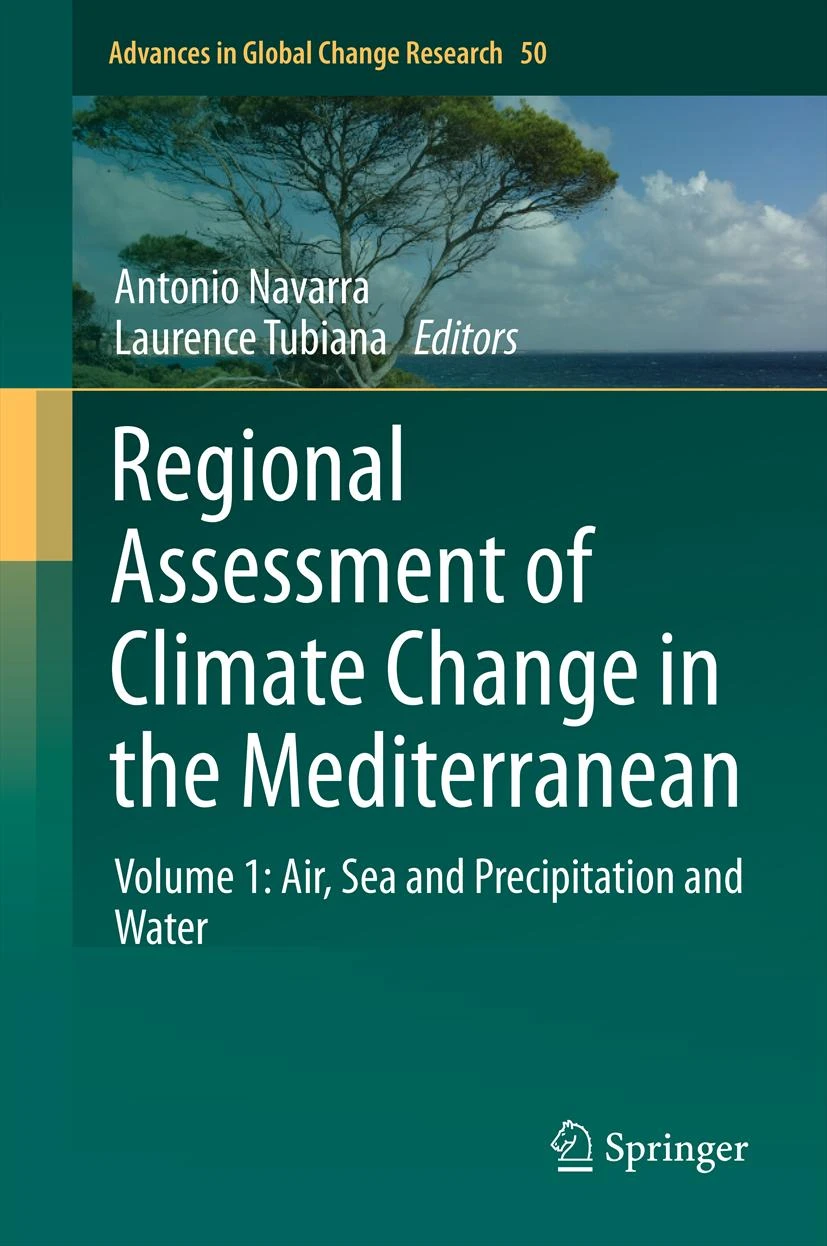
Regional Assessment of Climate Change in the Mediterranean | Volume 1: Air, Sea and Precipitation and Water

/
Cosa facciamo
/
/
/
Regional Assessment of Climate Change in the Mediterranean | Volume 1: Air, Sea and Precipitation and Water
2013

Regional Assessment of Climate Change in the Mediterranean
Volume 1: Air, Sea and Precipitation and Water

Editors: Antonio Navarra – CMCC President, Laurence Tubiana

Volume 1 of a three-volume final report describes, synthesizes and analyzes the results of the four-year Integrated Research Project CIRCE – Climate Change and Impact Research: Mediterranean Environment, funded by the EU 6th Framework Programme. Conducted under the auspices of the National Institute of Geophysics and Volcanology in Rome, Italy, CIRCE was designed to predict and to quantify the physical impacts of climate change in the Mediterranean, and to assess the most influential consequences for the region’s population. This volume incorporates the first two parts of the report, reviewing current knowledge of observed climate variability and trends in the Mediterranean, and including descriptions of available temperature and precipitation station and gridded data sets.

Explore the other volumes in the CIRCE series.
Volume 2
Volume 3

Introduction

Author: Antonio Navarra

Part I of this Report deals with the analyses of the physical aspects of climate change in the Mediterranean, aiming to assess possible changes under greenhouse concentrations scenarios, estimate uncertainties, detect and attribute past and present changes, understand mechanism and evaluate their relevance for the problem of climate change. This is realized with a vast arsenal of tools and techniques, including global and regional models, most of them specialized for the Mediterranean region, specific statistical analyses and new compilation of data sets for the region.

Chapter
Past and Current Climate Changes in the Mediterranean Region

Authors: Ulbrich U., Xoplaki E. (CMCC), Dobricic S. (CMCC), García-Herrera R., Lionello P. (CMCC), Adani M., Baldi M., Barriopedro D., Coccimiglio P., Dalu G., Efthymiadis D., Gaetani M., Galati M.B., Gimeno L., Goodess C.M., Jones P.D., Kuglitsch F.G., Leckebusch G.C., Luterbacher J., Marcos-Moreno M., Mariotti A., Nieto R., Nissen K.M., Pettenuzzo D., Pinardi N., Pino C., Shaw A.G.P., Sousa P., Toreti A., Trigo R.M., Tsimplis M.

Mediterranean climate change during the last 60 years is based on homogenized daily temperature and quality controlled precipitation observational data and gridded products. The estimated changes indicate statistically significant Mediterranean summer temperature increase and a reduction in winter precipitation in specific areas. Reconstructions of Mediterranean sea level suggest a rise of some 150 mm since the beginning of the nineteenth century. A 20 years long reanalysis (1985–2007) was produced, showing long term temperature variability and a positive salinity trend in the ocean layers from the surface to 1,500 m depth. A prominent increase in summer temperature extremes is found in the whole Mediterranean region, while warm bias in the mid twentieth century station data is removed by homogenization. No basin-wide trends in precipitation and droughts are found for the second half of the twentieth century, while trends in extreme winds are largely negative, as are those of the related cyclones and cut-off-lows. The role of large scale pressure patterns like the NAO for variabilities and trends is discussed for the different parameters considered.

Chapter
Future Climate Projections

Authors: Gualdi S. (CMCC), Somot S., May W., Castellari S. (CMCC), Déqué M., Adani M., Artale V., Bellucci A. (CMCC), Breitgand J.S., Carillo A., Cornes R., Dell’Aquila A., Dubois C., Efthymiadis D., Elizalde A., Gimeno L., Goodess C.M., Harzallah A., Krichak S.O., Kuglitsch F.G., Leckebusch G.C., L’Hévéder B., Li L., Lionello P. (CMCC), Luterbacher J., Mariotti A., Navarra A. (CMCC), Nieto R., Nissen K.M., Oddo P., Ruti P., Sanna A. (CMCC), Sannino G., Scoccimarro E. (CMCC), Sevault F., Struglia M.V., Toreti A., Ulbrich U., Xoplaki E. (CMCC).

In this chapter we show results from an innovative multi-model system used to produce climate simulations with a realistic representation of the Mediterranean Sea. The models (hereafter simply referred to as the “CIRCE models”) are a set of five coupled climate models composed by a high-resolution Mediterranean Sea coupled with a relatively high-resolution atmospheric component and a global ocean, which allow, for the first time, to explore and assess the role of the Mediterranean Sea and its complex, small-scale dynamics in the climate of the region. In particular, they make it possible to investigate the influence that local air-sea feedbacks might exert on the mechanisms responsible for climate variability and change in the European continent, Middle East and Northern Africa. In many regards, they represent a new and innovative approach to the problem of regionalization of climate projections in the Mediterranean region.

The CIRCE models have been integrated from 1951 to 2050, with initial conditions obtained from a long spin-up run of the coupled systems. The simulations have been performed using observed radiative forcing (solar constant, greenhouse gases concentration and aerosol distribution) during the first half of the simulation period and the IPCC SRES A1B scenario during the second half (2001–2050).

The projections indicate that remarkable changes in the Mediterranean region climate might occur already in the next few decades. A substantial warming (about 1.5°C in winter and almost 2°C in summer) and a significant decrease of precipitation (about 5%) might affect the region in the 2021–2050 period compared to the reference period (1961–1990), in an A1B emission scenario. However, locally the changes might be even larger. In the same period, the projected surface net heat loss decreases, leading to a weaker cooling of the Mediterranean Sea by the atmosphere, whereas the water budget appears to increase, leading the basin to loose more water through its surface than in the past. The climate change projections obtained from the CIRCE models are overall consistent with the findings obtained in previous scenario simulations, such as PRUDENCE, ENSEMBLES and CMIP3. This agreement suggests that the results obtained from the climate projections are robust to substantial changes in the configuration of the models used to make the simulations.

Finally, the CIRCE models produce a 2021–2050 mean steric sea-level rise that ranges between +6.6 cm and +11.6 cm, with respect to the period of reference. Within the CIRCE project the results obtained from these models have been used to investigate the climate of the Mediterranean region and its possible response to radiative forcing. Furthermore, the data have been made available for climate change impact studies that are included in the Regional Assessment of Climate Change in the Mediterranean that has been prepared in the context of the CIRCE project.


Chapter
Summary and Major Findings

Author: Antonio Navarra (CMCC)

An analysis of the observed climate change in the Mediterranean region has been performed, using homogenized daily temperature, quality controlled precipitation observational data and gridded products. The estimated changes indicate statistically a significant increase Mediterranean temperature during the summer and a reduction in winter precipitation in specific areas. Several numerical simulation projections suggest that remarkable changes in the climate of the Mediterranean region might occur on the scale of a few decades. A substantial warming (about 1.5°C in winter and almost 2°C in summer) and a significant decrease of precipitation (about 5%) might affect the region in the 2021-2050 period compared to the reference period (1961-1990), in an A1B emission scenario. Physicochemical mechanisms that formulate the air quality over the Mediterranean region and the resulted impacts on the regional climate have been described. The impacts of aerosols, distinguished in direct ( impacts on radiation budget), health (amounts of inhaled particles and impacts on health) and indirect effects (impacts on clouds and precipitation), are discussed on qualitative and quantitative way. Furthermore, a first assessment of the detection of a signal of temperature change over the Mediterranean domain has been performed using HadCRUT3v observation dataset and model outputs from the CMPI3 climate change modeling exercise. For this study we have used new formal detection methodologies developed within the context of the CIRCE project, in order to try to improve the ability to detect a climate change signal at the regional scale. The application of these methods lead to the conclusion that anthropogenic forcing is a plausible explanation for the observed changes in the area mean change of near surface temperature over the Mediterranean region. A first assessment of the detection of a signal of precipitation change over the Mediterranean domain due to internal climate variability has been also given in this section.


Authors

Start typing and press Enter to search

Shopping Cart