



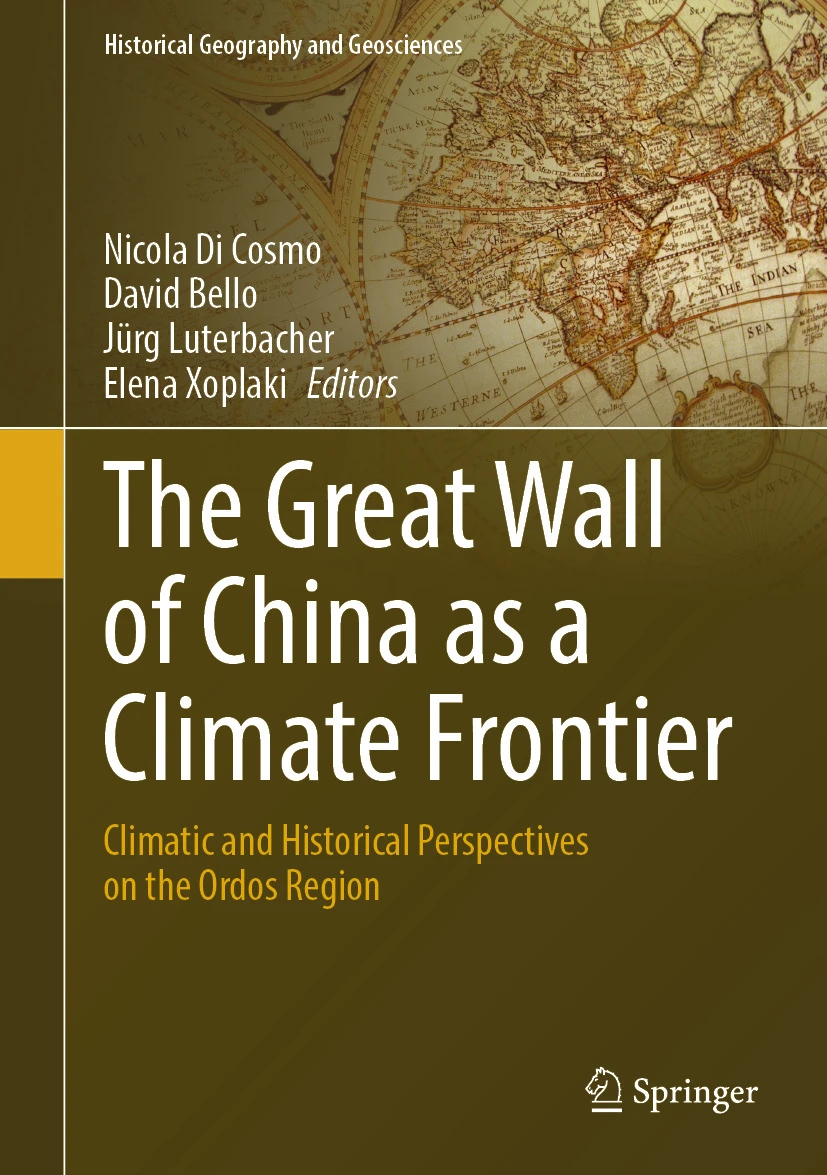
The Great Wall of China as a Climate Frontier. Climatic and Historical Perspectives on the Ordos Region

/
Cosa facciamo
/
/
/
The Great Wall of China as a Climate Frontier. Climatic and Historical Perspectives on the Ordos Region
2026

The Great Wall of China as a Climate Frontier
Climatic and Historical Perspectives on the Ordos Region

Editors: Di Cosmo N., Bello D., Xoplaki E., Luterbacher J.

The Great Wall—the most imposing manifestation of Chinese frontier history—crosses a vast territory subject to political, environmental and climatic instabilities that the volume approaches as mutually conditioning, focusing on the Ordos region. This has been a central point of contact between sedentary East Asian and nomadic Inner Asian peoples throughout Chinese premodern history (500 BCE-1800).  The contributors emphasize the significance of human-natural interaction affecting environmental and climatological variability central to historical processes on this critical frontier zone. Four case studies are supported by paleoclimatic evidence from documentary information and natural proxies as well as from land-use models showing the complexity of climate-human interplay, in terms of demography, economy, and administrative-military presence. The volume’s interdisciplinary methodology achieves an authoritative integration of both scientific (quantitative) and historical (narrative) approaches to produce a comprehensive history of long-term frontier dynamics.

Chapter 
The Ordos Region in the Instrumental Record and Large-Scale Influences

Authors: Luterbacher J., Xoplaki E., Luther N., Ma S., Argiriou A.A., Li Z., Qin C., Yang B., Ren G., Zhou T., Li X., Yang W., Kempf M., Haupt M., Mahmoud M., Bello D.A., Di Cosmo N.

This chapter examines seasonal temperature and precipitation variability, trends, and extremes across the Greater Ordos Region (GOR) during 1960–2021 CE. The region shows significant warming in both the warm (May–September) and cold (October–April) seasons, while precipitation exhibits no significant long-term trend, indicating a strong influence of interannual and decadal variability. Two dominant seasonal climate modes explain a substantial share of observed variability. In the warm season, a cool-dry mode is associated with tropical sea-surface temperature anomalies, including El Niño and Indian Ocean cooling, which weaken the East Asian Summer Monsoon, suppress convection, and reduce rainfall. A second warm-dry mode is linked to persistent continental high pressure and anomalous northerly flow, favouring atmospheric stability, reduced vertical mixing, and sustained warmth. In the cold season, a warm-wet mode reflects subtropical Pacific moisture transport and lagged ENSO influence, whereas a cold-wet mode is associated with the Siberian and Mongolian High, cold-air advection, and episodic southern moisture intrusions. Local topography, land-surface conditions, and soil-moisture feedbacks further modulate these large-scale influences. Temperature extremes have shifted markedly toward more frequent warm days and nights and fewer cold extremes. Precipitation extremes show spatially heterogeneous changes, including both intense short-duration rainfall and prolonged dry spells. Overall, the GOR emerges as a climatically heterogeneous semi-arid transition region shaped by interacting large-scale circulation and local controls.


Authors

Start typing and press Enter to search

Shopping Cart