



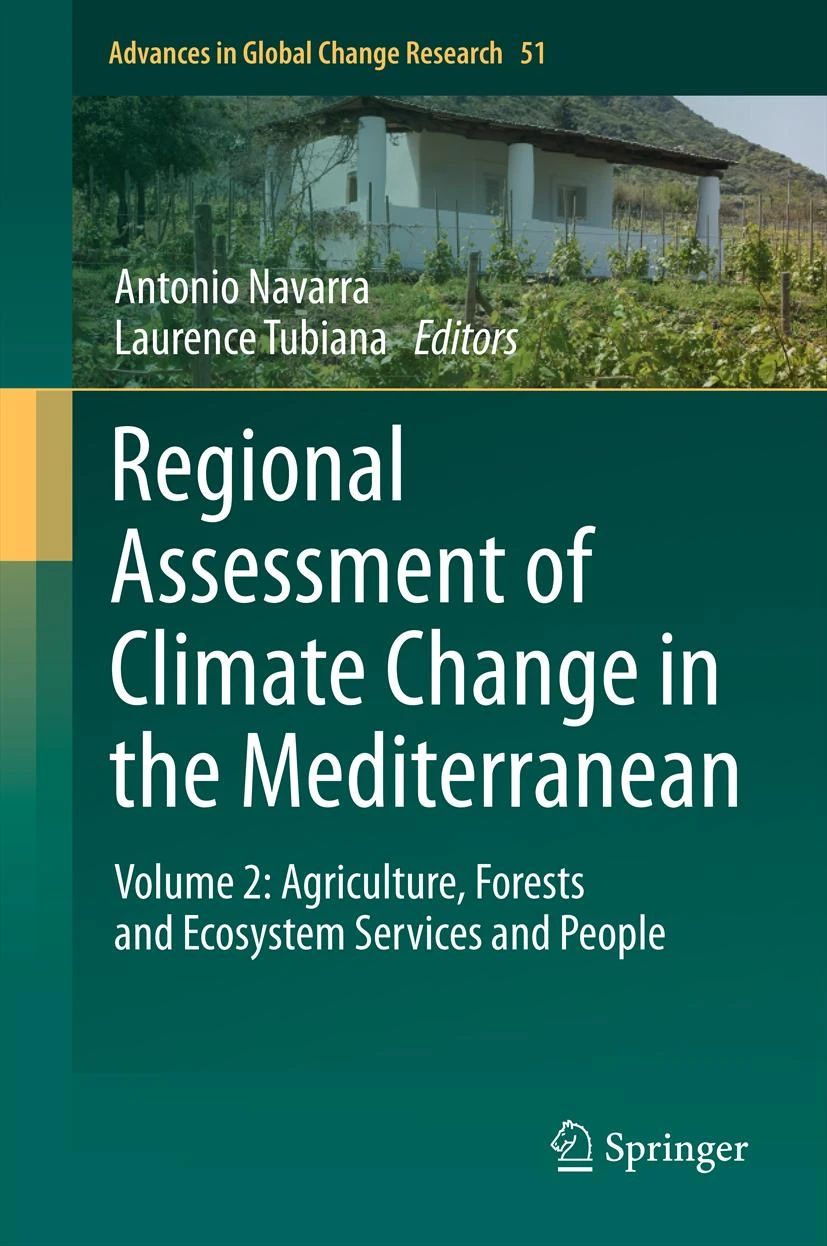
Regional Assessment of Climate Change in the Mediterranean | Volume 2: Agriculture, Forests and Ecosystem Services and People

/
What we do
/
/
/
Regional Assessment of Climate Change in the Mediterranean | Volume 2: Agriculture, Forests and Ecosystem Services and People
2013

Regional Assessment of Climate Change in the Mediterranean
Volume 2: Agriculture, Forests and Ecosystem Services and People

Editors: Antonio Navarra – CMCC President, Laurence Tubiana

Volume 2 of a three-volume final report thoroughly describes, synthesizes and analyzes the results of the four-year Integrated Research Project CIRCE – Climate Change and Impact Research: Mediterranean Environment, funded by the EU 6th Framework Programme. Conducted under the auspices of the National Institute of Geophysics and Volcanology in Rome, Italy, CIRCE was designed to predict and to quantify the physical impacts of climate change in the Mediterranean, and to assess the most influential consequences for the region’s population. This volume incorporates Parts 3 and 4 of the report, reviewing current knowledge of observed climate variability and trends in the Mediterranean, and including descriptions of available temperature and precipitation station and gridded data sets.

Explore the other volumes in the CIRCE series.
Volume 1
Volume 3

Introduction

Author: Monia Santini (CMCC), Riccardo Valentini (CMCC)

This introductive chapter is an overview about the importance of climate impact assessment for ecosystems and the services they provide. It is also highlighted how, in the global change perspective, not only climate but also socio-economic trends affect the vulnerability of ecosystem services and their adaptive capacity. A multidisciplinary research line in CIRCE project was devoted to the evaluation of the vulnerability of ecosystem services in the Mediterranean region to climate change and other forcings, and to the investigation of feedbacks among ecosystems, climate, water and carbon cycle, including consideration of extreme events and disturbances as fires.

Summary and Major Findings

Author: Monia Santini (CMCC), Riccardo Valentini (CMCC)

This chapter resumes major and common findings among chapters 2 to 7. Focus is given to the spatial heterogeneity of Mediterranean region in terms of ecosystem vulnerability to climate change impacts. Further, the role of spatio-temporal scale of evaluation is noteworthy, as well as taking into account extreme events and thresholds in the interaction among climate and its effects.

Chapter
Integrated Socio-Economic Assessment (The Economic Point of View)

Authors: Francesco Bosello (CMCC), Mordechai Shechter 

This section introduces the main methodologies used by the climate change impact science to assess economically the consequences of climate change. Furthermore it presents the main findings of this literature focusing specifically on possible future economic consequences of climate change in the Mediterranean area emphasizing the new knowledge in this field brought by the CIRCE project. The robust finding of the literature points out a low economic vulnerability of Euro-Mediterranean countries (with losses ranging from −0.25 to −1.4% of GDP for extreme temperature scenarios or even slight gains), and a higher vulnerability of North African and Eastern-Mediterranean countries (of roughly 2% of GDP by the mid of the century). Against this background the CIRCE project proposes one of the first attempts to perform a detailed integrated impact assessment exercise focusing on the Mediterranean area. With the IPCC A1B SRES scenario as ­reference, impacts related to energy demand, sea-level rise and tourism, have been economically assessed by a general equilibrium model. The Mediterranean as a whole loses 1.2% of GDP with the Northern-Mediterranean countries clearly less ­vulnerable than the Southern-Mediterranean ones. Among the former the average loss in 2050 is 0.5% of GDP, while among the latter this more than doubles. Particularly adversely affected are Cyprus, Albania and the Eastern Mediterranean region (−1.6, −2.4, −1.5% of GDP respectively in 2050). In terms of impact types, tourism and sea-level rise are clearly the most threatening, while GDP impacts induced by demand re-composition of energy use is less of an issue and often positive.


Authors

Start typing and press Enter to search

Shopping Cart