



Workshop
8-10 June 2026 | Venice
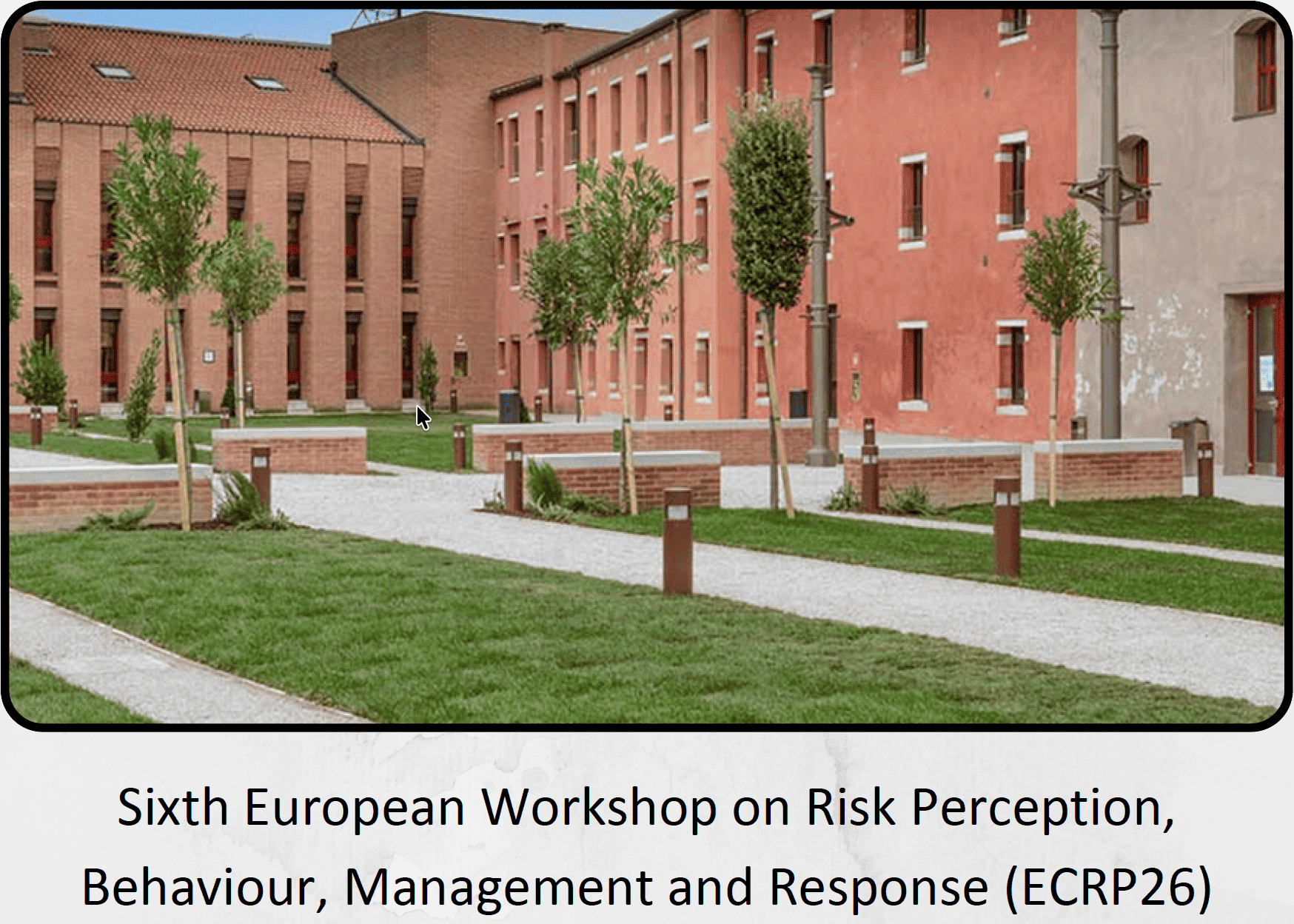
The Sixth European Workshop on Risk Perception, Behaviour, Management and Response (ECRP26) – Risk SoS workshop, organized by CMCC together with Ca’ Foscari University of Venice and Institut Polytechnique de Paris, explores how behavioural dynamics, risk perception, and societal responses can be better integrated into systemic risk and resilience modelling.
Bringing together researchers and practitioners, it showcases innovative approaches for incorporating behavioural factors into risk assessments, including risk storylines, survey-based studies, AI-enabled risk applications, Agent-Based Modelling, and empirical validation techniques. Through case studies and interdisciplinary dialogue, the workshop aims improve systemic risk assessment, enhancing resilience planning, and identifying effective strategies for climate adaptation and disaster risk management.
Full description of the workshop
The EU vision of a disaster- and climate-resilient society cannot be achieved by relying on “behaviour-blind” assessments, modelling, and policy frameworks. Evidence increasingly shows that behaviour shapes risk outcomes in ways that hazards alone cannot explain. However, current risk assessments, models, and simulations often fail to account for how the actions of individuals, businesses, and public services before, during, and after a crisis influence damage levels, recovery processes, and overall resilience. Subsequently, they remain poorly understood and difficult to formalize.
Moreover, behavioural dynamics can act as potential risk amplifiers or wildcards, triggering cascading effects and potentially leading to systemic failures and risk propagation across systems and sectors.
While the importance of a systemic approach to risk and resilience is widely acknowledged (IPCC, 2022; UNDRR, 2015), research still remains fragmented. Many studies operate in disciplinary silos: some focus on biophysical or environmental processes, while others examine social or behavioural dimensions. As a result, insights often evolve in parallel, without a coherent framework to integrate societal behaviour and decision-making with biophysical dynamics.
In addition, most risk assessments still rely on conventional frameworks based on hazard, exposure, and vulnerability, while overlooking the crucial role of societal “response” – the capacity of individuals, communities, and institutions to anticipate, adapt, and react to risk – (IPCC, 2021). Explicitly incorporating response as a fourth driver of risk can strengthen the social construction of risk perspective and help bridge the gap between risk science and practical resilience planning. At the same time, many modelling approaches remain disconnected from empirical data, limiting their applicability in real-world contexts and constraining the comparability and generalisability of findings across scales and settings.
Despite growing recognition of these challenges, the integration of behavioural dynamics into policies, risk management practices, and modelling frameworks – and their transferability across contexts – is still not satisfactory. Addressing this gap requires a broader and more diverse theoretical foundation to improve model integration, deepen understanding of risk and adaptation processes, and enable cross-validation of case studies.
Addressing these challenges requires new thinking across disciplines.
CMCC, together with Ca’ Foscari University of Venice and Institut Polytechnique de Paris, organized this workshop to set out to bridge that gap and explore how behavioural dynamics, risk perception, and societal response can be integrated into systemic risk and resilience modelling. During the event, we will highlight recent advances in Disaster Risk Reduction (DRR) and Climate Change Adaptation (CCA) research, covering integrated modelling approaches and case studies that address real-world challenges. The workshop will explore both qualitative and quantitative approaches for incorporating behavioural factors into risk assessments, including risk storylines, survey-based studies, AI-enabled risk applications, Agent-Based Modelling, and empirical validation techniques. The workshop emphasizes co-development of solutions by engaging relevant stakeholders and risk owners from the design stage, ensuring models reflect actual decision-making challenges.
By integrating insights from EU and international projects, the workshop will foster forward-looking discussions on improving systemic risk assessment, enhancing resilience planning, and identifying effective strategies for climate adaptation and disaster risk management.
Workshop format
• Presentations on the state-of-the-art risk and resilience analysis and applications from EU and international projects.
• Moderated discussions and working groups on key research questions.
• Collaborative sessions to explore new ideas for future project proposals.
Key questions to be addressed
1. How can behavioural dynamics and risk perception be integrated into systemic risk and adaptation models to better capture real-world decision-making and adaptive feedback in complex disasters?
2. Why do individuals and communities fail to adopt adaptive behaviours despite increasing availability of hazard and risk information?
3. How can the dynamic interplay of hazard, exposure, vulnerability, and response be embedded into operational, empirically grounded risk models?
Speakers
Silvia Torresan, CMCC
Davide Mauro Ferrario, CMCC
Timothy Tiggeloven, CMCC
Francesco Maria D’Antiga, CMCC
Igor Linkov, CMCC
Marta Ellena, CMCC
Andrea Critto, CMCC
Samuele Casagrande, CMCC
Fulvio Biddau, CMCC